


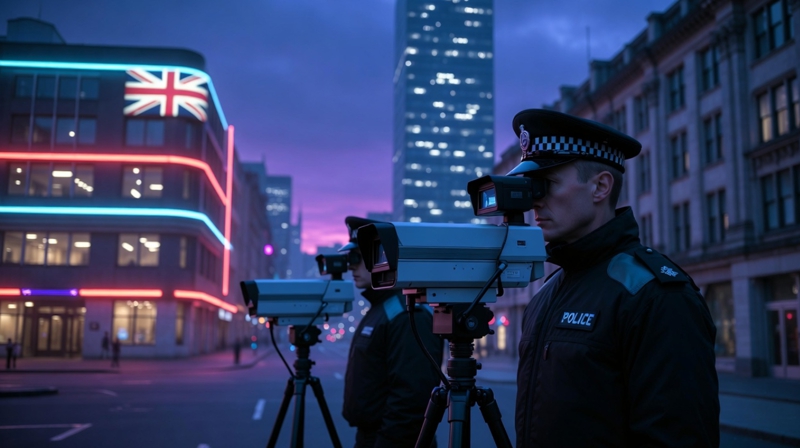


With sophisticated precrime tools at its disposal, the proposed national police force & digital forensics agency would have more power & visibility into everyone’s lives: perspective
The Tony Blair Institute for Global Change (TBI) calls for nationwide facial recognition rollouts, the establishment of a “single national police force,” and the creation of “national digital forensics agency.”
Without ever addressing the root causes for rising crime in the UK, the Blair Institute has reverted to technocracy as a solution.
Published on January 23, 2026, the commentary piece “Policing That Makes Britain Safer – Not Just Better at Counting Crime” provides recommendations that would give law enforcement more power and visibility into everyone’s lives, starting with ubiquitous live facial recognition.
“Tackling crime requires a whole-of-country effort. Facial-recognition technology must urgently be rolled out UK-wide, and other innovative tech must be utilized to stop criminals before they strike”
Tony Blair Institute for Global Change, “Policing That Makes Britain Safer – Not Just Better at Counting Crime,” January 2026
Lamenting that live facial recognition technology was only used by 13 police forces, the commentary argues that this type of biometric surveillance should be deployed everywhere in the UK.
Citing the London Metropolitan Police making over 1,300 arrests using facial recognition over the past two years, the Blair Institute makes the claim that the “results are striking” wherever this technology is used.
But in justifying the need to biometrically surveil everyone in the UK, the paper completely leaves out any mention of privacy concerns, government overreach, or public opinion on the matter.
Instead, the Blair Institute claims, “To deny this technology purely through reasons of competence and geography is a social injustice.”
In other words, if you’re against being constantly biometrically tracked, traced, and monitored everywhere you go in the UK, you are committing a social injustice.
And to combat social injustice, TBI proposes the creation of a single national police force in addition to a national digital forensics agency.
“We also recommend the creation of a national digital forensics agency, because digital evidence now sits at the heart of most investigations and capacity varies wildly across the country”
Tony Blair Institute for Global Change, “Policing That Makes Britain Safer – Not Just Better at Counting Crime,” January 2026
Because criminals can cross jurisdictional boundaries, the Blair Institute wants to create a “single national police force” in a move that would see a greater consolidation of law enforcement power.
The logic being, “Criminals do not respect force boundaries. Neither should core policing capability.”
These boundaries extend into the digital realm.
According to the commentary, “Nearly half of all crime now crosses [police] force boundaries or happens online.
“Reducing the number of forces by strengthening the regional tier and creating a single national police force to lead on serious and organized crime, cybercrime and counterterrorism is the way forward.”
Alongside this national police force would be a national digital forensics agency.
If you thought getting a visit from the police over a social media post the government doesn’t like was bad, the national digital forensics agency would have even more sophisticated precrime tools at its disposal to flag undesirables as potential criminals.
“What is needed is a unified national policing app – a single digital front door for citizens in need of help from the police”
Tony Blair Institute for Global Change, “Policing That Makes Britain Safer – Not Just Better at Counting Crime,” January 2026
In addition to nationwide facial recognition rollouts, the creation of a single national police force, and the establishment of a national digital forensics agency, the Blair Institute wants the UK to build a unified national policing app.
They say this app would “help citizens in need of help from the police.”
And by “help” they mean that the app would “provide comprehensive victim support and allow people to track the status of reported crimes in real time because that.”
This app “is ultimately about respecting victims and their right – their need – for information.”
The idea is that this new model of data-powered policing should be “personalized, preventative, and always on.”
And of course, digital ID would sit at the heart of all these precrime technologies.
“Britain’s crime problem in 2026 is no longer primarily violent, local or analogue. It is digital, organized and scalable. Policing must catch up”
Tony Blair Institute for Global Change, “Policing That Makes Britain Safer – Not Just Better at Counting Crime,” January 2026
At its core, the Blair Institute wants to give law enforcement predictive policing powered by precrime technologies and massive biometric data collection.
“A modern policing system should feel more like a high-quality, responsive urgent-care system: a clear point of entry, transparent triage, real-time updates and early intervention that stops the next crime, not just records the last one,” the author writes.
Everything the Blair Institute promotes is about collecting population data for the digital panopticon.
Last year, TBI published the report, “Governing in the Age of AI: Building Britain’s National Data Library,” calling for a digital ID-linked National Data Library for the entire UK in order to feed AI systems for government services.
“None of this would be possible without efforts to improve the broader data infrastructure, including efforts around interoperability and digital identity”
Tony Blair Institute for Global Change, Governing in the Age of AI: Building Britain’s National Data Library, February 2025
The UK National Data Library is envisioned to house all of Britain’s data, including that related to:
- Health
- Energy
- Households
- Pensions
- Agriculture
- Education
- Labor
- Taxation
- Justice
- And so much more
The idea is to create a unified, interoperable library that links data on basically everyone and everything that exists in the UK.
Digital ID is the linchpin to all these government “services,” which now includes predictive policing.
The latest commentary, “Policing That Makes Britain Safer – Not Just Better at Counting Crime” was written by TBI senior director for policy and politics Ryan Wain.
Wain “played a leading role in developing, delivering and communicating TBI’s pandemic work. Those efforts changed government policy on vaccines to a “first dose to many” strategy that, studies show, prevented thousands of deaths,” according to his bio.
In April 2020, TBI compared the COVID-19 response to a wartime effort, encouraging contact tracing, vaccine passports, and other Orwellian measures:
“One consequence of a wartime mindset is putting options on the table that would not normally be considered. This throws up particular policy dilemmas in domains like privacy, data sharing, intellectual property and content moderation, where open societies traditionally place a high value on individual rights and freedoms. In the face of an urgent and unprecedented global crisis, it will be appropriate to reconsider how these policy trade-offs are calibrated, but we must do so consciously.”
The Tony Blair Institute openly says that rights and freedoms should be reconsidered “consciously” whenever a crisis is declared.
And just as the UK’s Online Safety Act comes into force with internet passports in the form of biometric age verification, TBI wants facial recognition technology deployed everywhere, along with the creation of a national police force and national digital forensics agency — all for the safety of Britons.
Image Source: AI generated with Grok