


‘Age assurance’ is a backdoor for digital ID, internet passports & biometric surveillance to end online anonymity for all users: perspective
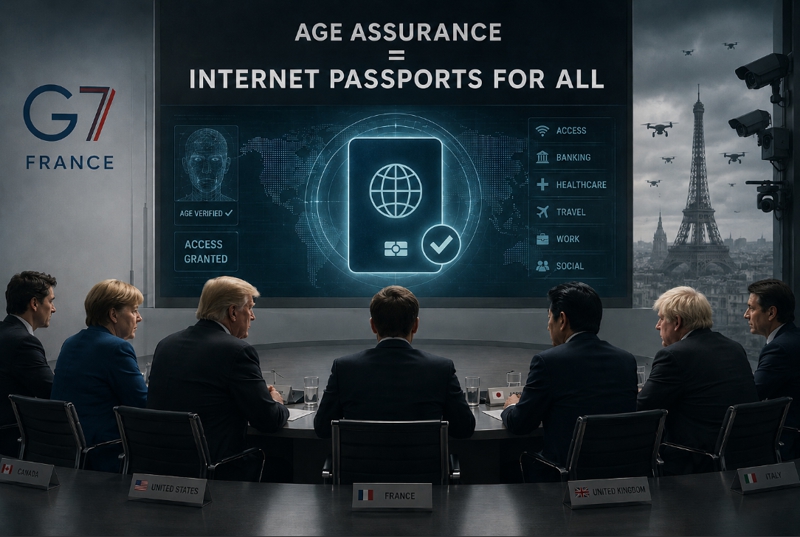
Leaders of the G7 call on big tech companies to develop and deploy internet passports for all users through “effective and innovative age assurance mechanisms.”
On Wednesday, the Group of Seven (G7) leaders from Canada, France, Germany, Italy, Japan, the UK, and the US, the non-enumerated member and the European Union, in collaboration with their partner countries Brazil, Egypt, India, Kenya and the Republic of Korea, published their “Leaders’ Call on a Safer Digital Space for Minors,” in which they committed to provide what they considered to be “a safe digital space for our minors, which include children and youth under 18.”
However, when it comes to so-called “age assurance” mechanisms, they are nothing more than a backdoor to digital ID and internet passports for every single online user, no matter their age.
There is no mention of “social media” anywhere in the G7 leaders’ call — this “age assurance” is meant for all “digital spaces” and is applicable to everyone of all ages.
“We call on digital service providers to develop and apply technology and systems that ensure safe, secure and age-appropriate experiences including through effective and innovative age assurance mechanisms while preserving the privacy of users according to respective jurisdictions, national circumstances and applicable legal frameworks”
G7, Leaders’ call on a safer digital space for minors, June 2026
According to the European Commission, “Age assurance refers to the methods used to determine an individual’s age with different levels of confidence or certainty. They can be grouped into three main categories: age estimation, age verification, and self-declaration.”
Self-declaration is just you clicking a button to say you are of a certain age, but governments and globalists don’t want this.
They prefer age estimation and age verification.
Age estimation is obtained through various means such as biometrics like taking a selfie, through natural language processing where your text and speech is analyzed, or through behavioral profiling that tracks your online activity, including your browser history.
“Behavioral Profiling: Analyzing the profiling data of users based on their activity online by employing AI could provide an estimate of users’ age. For instance, this analysis could include scrutiny of browsing history, user-generated content, purchases, and so on”
European Commission, Research report: Mapping age assurance typologies and requirements, April 2024
Age verification is all about using what the EC calls “hard identifiers” such as digital ID, credit cards, passports, and digital wallets to verify one’s age.
These are all age assuarance mechanisms. These are all internet passports. These are all aimed at adults.
What child owns a credit card, a bank account, or a digital wallet?
Getting back to the call for age assurance on Wednesday, the G7 leaders’ call also welcomed the “G7 Common Set of Principles defining a safer and more secure digital space for minors,” which was published and adopted by G7 ministers a few weeks earlier on May 29.
“Effective age assurance is key to ensure a safer, more secure, and age-appropriate experience for minors: Because protecting freedom of expression and privacy is a core part of protecting minors online and fundamental to free societies, age assurance should be applied in ways that allow for, when needed, parental consent, and compliance with applicable legal obligations through the least invasive means, that are appropriate, privacy-preserving, fair and technically feasible”
G7, Common Set of Principles defining a safer and more secure digital space for minors, May 2026
The G7 “Leaders’ Call on a Safer Digital Space for Minors” came just two days after UK Prime Minister Keir Starmer announced that his government would ban for social media for everyone under the age of 16.
Beneath the rhetoric of protecting children lies a truth far more insidious — internet passports for all — a march to end online anonymity where everything you say and everything you do is pegged to your digital ID.
In order to keep under 16s off of social media, everyone 16 and older must also submit to an identity check, and that is what these social media bans and so-called age assurances are all about.
Parental controls on apps already exist. Laws to protect children are already in place.
So, what’s the point of social media bans and age assurance mechanisms?
Digital ID and internet passports are the end goal — to control what information you are allowed to access, what you are allowed to say, and how you are able to transact.
Starmer made this agenda abundantly clear last September when he said his government was going to force digital ID on every worker in the UK. No digital ID, no work.
Again, there were already laws in place for employers to verify their employees’ rights to work without the need for digital ID.
But it’s not just the G7 that is pushing forward with internet passports for all.
This is a global agenda, which The Sociable covered in great length last year with the story, “Digital ID, face scans for age verification are becoming internet passports: Online age checks are not just about children; they’re about getting everybody onboard with digital identity and biometric surveillance.”
When the same messaging and the same policies are being bombarded upon the public at the same time, that’s a pretty good sign there’s a major PSYOP underway.
If you add that to any dismissal of dissenters, labeling them as people who don’t care about protecting children, you can all but guarantee that you’re being gaslit into a PSYOP.
Another aspect of PSYOPs is the artificially fabricated position of urgency — in that, if we don’t take action now, everything will go to hell and be wasted.
Now, we are seeing WHO veteran Ilona Kickbusch, who, after stating, “A strong G7 statement on children and social media is a test of whether G7 governments are serious about governing the technologies that are reshaping human development,” published something in Global Governance Media that would make World Economic Forum (WEF) founder Klaus Schwab blush: “The political window for decisive action is open.”
“Parents, clinicians, educators and increasingly young people themselves are demanding accountability. The political window for decisive action is open”
Ilona Kickbusch, Children’s safety in digital environments is a G7 issue, June 2026
Now where have we heard that kind of rhetoric before?
You know, the kind that says the moment to strike is now, when everyone is emotional and not thinking clearly, and they are therefore far more easy to manipulate?
Remember the launch of the WEF’s great reset agenda in June 2020?
At the time, Klaus Schwab declared, “The pandemic represents a rare but narrow window of opportunity to reflect, reimagine, and reset our world to create a healthier, more equitable, and more prosperous future.”
In the same vein, King Charles III, back when he was still a prince, said, “We have a golden opportunity to seize something good from this crisis — its unprecedented shockwaves may well make people more receptive to big visions of change.”
In 2020 the coronavirus crisis presented a golden opportunity for the global establishment to further its agenda upon a frightful and angry population that had been so beaten down by the pandemic and subsequent lockdowns that they would have become more susceptible to giving over their freedoms to the idea of greater centralized power and control.
Today, internet passports are the same digital ID solution to another invisible boogeyman.
This time, instead of issuing contact tracing and demanding vaccine passports, which themselves are a form of digital ID — under the guise of public health and safety — the official position is to demand internet passports under the guise of child safety and protection.
Digital ID for everyone has always been the goal of governments and unelected globalists alike. It is the linchpin for all systems of digital control.
In September 2018 the WEF published a report stating that digital identity would determine your level of access to information.
“This digital identity determines what products, services and information we can access – or, conversely, what is closed off to us”
WEF, Identity in a Digital World: A new chapter in the social contract, September 2018
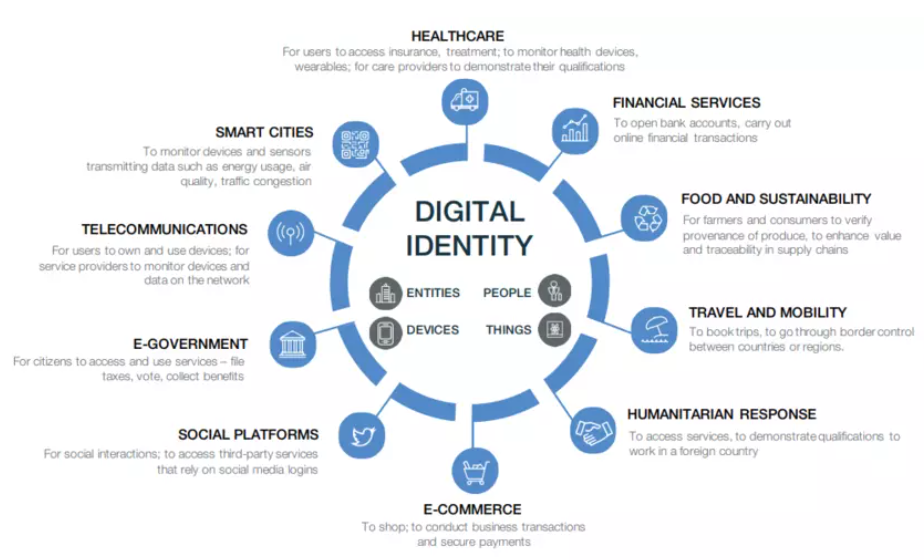
Fast-forward eight years, and this is has become a reality as digital IDs and biometric facial scanning become the new normal for passing internet checkpoints.
New laws, principles, pacts, and policies all come under the guise of “child safety,” but when looked at through a different lens, the message can be easily inverted to mean “adult endangerment” as everyone’s speech and access to information will be dependent upon some form of digital ID for accessing search engines and social media.
The agenda to require digital identity and biometric surveillance in order to access social media platforms and to use search engines has been years in the making.
“I propose putting an end to anonymity on social media […] I believe we must push forward the principle of pseudonymity as the functioning element of social media and force all these platforms to link every user account to a European digital identity wallet”
Spanish PM Pedro Sanchez, WEF Annual Meeting, January 2025
The technological foundation is in place, but the rules have been set in pencil.
If you didn’t show proof of vaccination during lockdowns, you were “killing grandma.”
Now we’re going from vaccine passports to internet passports.
If you don’t agree to internet passports, you are harming children.
It’s all inverted.
Whether through a government mandate or through the fusion of corporation and state via public-private partnerships, the years-long agenda to rollout internet passports is plowing full-steam ahead.
Image Source: AI generated with ChatGPT