




The next strategic advantage in defense may not come from having more satellites in orbit, but from controlling what they can see, how quickly they can collect information and who has access to that data. As geopolitical tensions reshape Europe’s security priorities, governments are looking beyond traditional defense infrastructure toward space-based intelligence systems that can provide independent, continuous and reliable information.
The shift is also creating opportunities for commercial space companies. Satellite imagery, Earth observation and thermal sensing are becoming increasingly relevant to national security, critical infrastructure protection and crisis management, putting greater emphasis on the companies developing the technologies behind these capabilities.
The economic opportunity is substantial. A 2024 report by McKinsey and the World Economic Forum estimated that the global space economy could reach $1.8 trillion by 2035, up from $630 billion in 2023. The research identifies defense, transportation, supply chains and digital communications among the industries expected to drive that expansion.
However, the opportunity extends beyond the commercial value of satellite services. For European governments, space infrastructure is increasingly connected to strategic autonomy: the ability to collect, process and secure information without depending entirely on foreign systems or providers.
Why Europe is investing in sovereign space capabilities
The scale of Europe’s defense investment illustrates the direction of this transition. According to the European Defence Agency’s 2025–2026 Defence Data report, the 27 EU Member States spent €418 billion on defense in 2025, a 20% increase from the previous year. Spending is projected to reach €454 billion in 2026.
Space is becoming part of that investment equation. Governments are increasingly considering commercial satellite services as part of their defense infrastructure, while seeking greater control over data collection, access and operational requirements.
The development signals a change in procurement priorities. Rather than relying entirely on external providers, European countries are looking to strengthen their own intelligence, surveillance and reconnaissance (ISR) capabilities and establish the industrial capacity needed to support national security requirements.
Earth observation is becoming a larger market
The commercial opportunity is also reflected in Earth observation (EO), the use of satellite-based sensors to collect information about the planet and monitor changes across land, water and infrastructure.
The European Union Agency for the Space Programme (EUSPA), in its 2026 EU Space Market Report, projects that global Earth observation revenues will increase from €3.5 billion in 2024 to €7.9 billion by 2034.
The forecast reflects growing demand across agriculture, energy, raw materials, infrastructure and other applications. It also points to the increasing value of transforming satellite observations into actionable information rather than simply collecting imagery.
For security and defense applications, that distinction matters. Governments need more than occasional images of a location. They require reliable observations that can help identify changes, assess activity and provide context for decisions.
Different satellite technologies address different parts of that requirement. Optical imaging provides visual information, while radar systems can collect observations under conditions that limit conventional optical imaging. Thermal infrared sensors add another layer by detecting temperature patterns and changes.
This creates an opportunity for specialized satellite providers developing complementary observation capabilities.
From wide-area monitoring to high-resolution thermal intelligence
One company working in this segment is Hydrosat, which develops thermal infrared satellite solutions for commercial and government applications.
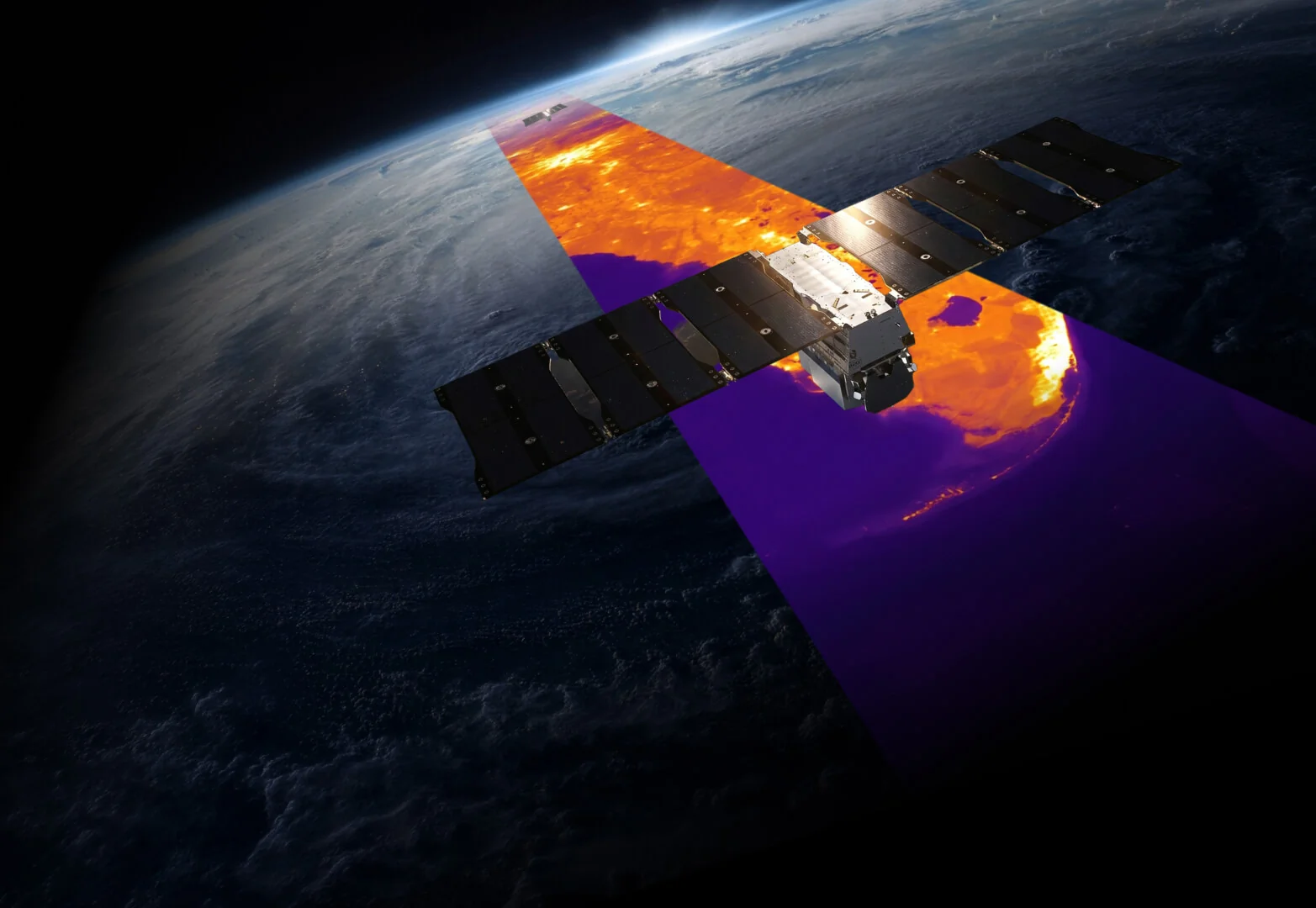
Its Osiris constellation is designed to provide broad-area thermal monitoring through longwave infrared (LWIR) technology, covering a 340-kilometer swath. The system is intended to identify temperature changes across large regions and provide context about the conditions surrounding an event.
The company is also developing Nyktòs, a high-resolution mid-wave infrared (MWIR) program designed for tactical intelligence, surveillance and reconnaissance. Unlike wide-area monitoring, the capability will allow customers to task thermal observations of smaller features in greater detail, with day-and-night imaging.
The two systems are intended to work together through a process known as tipping and cueing. Broad-area monitoring can identify unusual activity and direct higher-resolution observations toward specific locations for closer analysis.
Combined with historical, optical and radar data, the approach could help governments investigate activity, monitor changes over time and distinguish relevant thermal signals from their surrounding environment.
The same capabilities could support emergency response teams prioritizing areas for assessment and infrastructure operators monitoring facilities that require attention.

Hydrosat’s development plans also reflect the growing importance of regional industrial capacity. The company intends to expand its European technology and manufacturing footprint, open additional facilities and develop relationships with European supply chain partners.
The expansion is designed to support sovereign missions for NATO and allied customers, with capabilities that can be configured around national requirements for tasking, control, security and data access. Commercial constellation capacity could complement dedicated missions by providing additional observation opportunities and broader regional coverage.
For Hydrosat CEO and co-founder Pieter Fossel, the investment is tied to Europe’s ability to develop independent space capabilities.
“Europe’s investment in space is an investment in its ability to protect its interests and make independent decisions. We are committed to helping turn that ambition into capability,” Fossel said.
The company’s Chief Technology Officer, Scott Soenen, described the relationship between wide-area monitoring and high-resolution imaging as central to its approach.
“Finding and understanding activity on the ground requires both monitoring of wider areas and the ability to examine specific locations in detail,” Soenen said.
Hydrosat’s European expansion comes as governments increase spending on defense technology and seek greater control over the infrastructure supporting national security. The combination of sovereign mission capabilities, commercial satellite constellations and increasingly specialized thermal imaging systems could become an important part of how governments gather and interpret intelligence from space.

Disclosure: This article mentions a client of an Espacio portfolio company.