

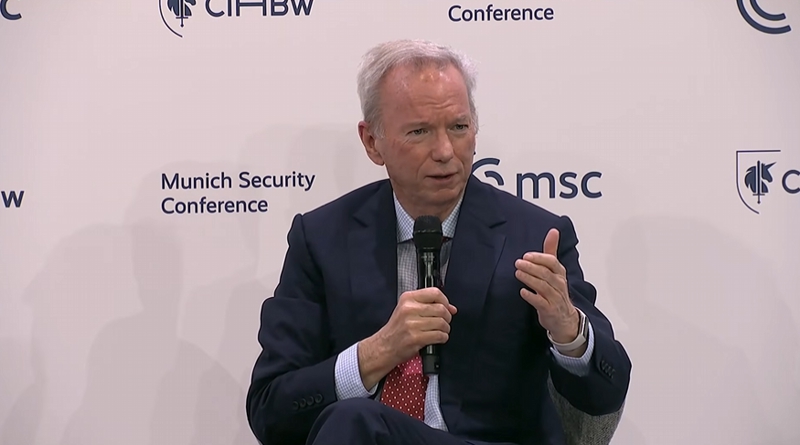


The war in Ukraine shows that algorithmic warfare is the future, and with it will come an enormous number of Zero-Day cyberattacks, according to ex-Google CEO Eric Schmidt at the Munich Security Conference (MSC).
“If you can write code, you can also write cyberattacks, so one of the things that’s going to happen is you’re going to have an enormous number of Zero-Day cyberattacks”
Eric Schmidt, Munich Security Conference, February 2026
“Every successful war will fundamentally have AI as a strategic base and as its targeting base […] In order to do this you have to have lots of training data […] All of these are playing out right now between Russia and Ukraine”
Eric Schmidt, Munich Security Conference, February 2026
Speaking today at the Munich Security Conference, Henry Kissinger’s best friend told the audience that the war in Ukraine was being studied and used for collecting training data in order to feed AI systems for planning future wars.
“Every successful war will fundamentally have AI as a strategic base and as its targeting base,” said Schmidt.
“In order to do this you have to have lots of training data, so the key with AI is that the system has to learn, and thank goodness there aren’t that many wars, but things like, ‘How do you identify targets? What does the enemy do? How do they respond?’
“All of these are playing out right now between Russia and Ukraine.”
With autonomous, algorithmic warfare comes the ability for machines to write code, including novel ways to create cyberattacks.
For years, the World Economic Forum (WEF), along with its founder Klaus Schwab, have warned about a coming cyber pandemic, with multiple simulations played out through various Cyber Polygon exercises.
At Cyber Polygon 2020, Schwab warned, “We all know, but still pay insufficient attention to, the frightening scenario of a comprehensive cyber attack, which would bring a complete halt to the power supply, transportation, hospital services, our society as a whole.
“The COVID-19 crisis would be seen in this respect as a small disturbance in comparison to a major cyber attack.”
Fast forward to today, and Schmidt is warning about future wars leading to not just one crippling cyberattack, but “an enormous number of Zero-Day cyberattacks.”
“If you can write code, you can also write cyberattacks, so one of the things that’s going to happen is you’re going to have an enormous number of Zero-Day cyberattacks coming out of this because of this innovation cycle,” said Schmidt at the MSC.
“AI and AI servers that are used in the military are legitimate military targets and therefore need to be hardened and protected. They need to be hardened physically. They need to have reliable power, but also the models.
“There are things called adversarial attacks where you can go in and take the model, which from your perspective is just a bunch of numbers, and change them enough that the AI does the wrong thing.”
Throughout the entire session, Schmidt emphasized that automation would dominate all future battlefields from the driverless drones to the planning and executionary AI agents.
“Algorithmic warfare is the future. It’s how war will be done […] I’m not in any way endorsing this, but this is happening very, very quickly in Ukraine”
Eric Schmidt, Munich Security Conference, February 2026
When it comes to traditional tanks, ships, and fighter jets, Schmidt said that “in every case there’s going to be an automation equivalent of that.”
“Instead of buying tanks, you’ll be buying unmanned ground vehicles. Instead of buying big ships, you’ll be buying the equivalent of drone ships — automated in various ways.
“In terms of air force you’ll have drones, and the drones will be attack drones, but the drones will also be able to defend themselves. This is the future of war.”
“How do we solve this problem with abundance, with inexpensive systems that work well in swarms? That technology now works”
Eric Schmidt, Munich Security Conference, February 2026
On the AI strategy side, Schmidt said that AI agents would be used to plan battles.
“What agents do you build for war?” he questioned.
“Every general I’ve met talks about how they want to have battlefield awareness, and they want to be able to see everything.”
Seeing is one thing.
Being able to develop a strategic battle plan, and being able to show your work step-by-step and prove that you will be successful is a complete game changer.
“Here’s what I want […] I want the computer to give them a plan, a battle plan, that we can prove will win in a series of iterations […] Reinforcement learning allows you to sort of prove what the optimal paths are“
Eric Schmidt, Munich Security Conference, February 2026
“Most people when they talk about AI, they talk about it in the context of Project Maven […] It was very controversial; Google started it with the Pentagon; Google canceled it — I was on the Pentagon side, which was a mess, and eventually it’s been taken over largely by Palantir”
Eric Schmidt, Munich Security Conference, February 2026
Deterrence in future wars will be based on not knowing what the opponent’s algorithms can do or what data they are trained on for certain scenarios.
Schmidt loves to mention he was Kissinger’s best friend at seemingly every talk he ever gives, and the Munich Security Conference 2026 was no different, where he recollected talking with the controversial statesman about deterrence in the 1950s.
“Henry Kissinger and I were best friends. We wrote two books together, and of course I miss him every day […] Henry would tell all these stories about how he did deterrence and how the deterrence in the 1950s was erected”
Eric Schmidt, Munich Security Conference, February 2026
In Kissinger’s time, deterrence was based on counting things like how many nuclear weapons the opponent had.
Schmidt says that type of deterrence is no longer case.
“I’m talking about a world where you don’t know — you can’t model what the algorithms are going to do.
“Algorithmic warfare should be extremely self-deterring because of that issue.“
But before the machines and the algorithms dominate the future of warfare, they first have to be built, powered, and programmed, which takes a lot of resources like raw materials, land, water, and energy.
A typical nuclear power plant can generate about 1.5 gigawatts of electricity.
However, in order to power its AI data centers, the US is going to need 90 gigawatts of additional power, according to Schmidt.
“The majority of the world — the third world if you will — the other countries that we don’t typically visit, are typically going to be using Chinese models, not American models, whereas Europe […] does not have the scale, does not have the data centers, does not have the financing to do it. This is a tragedy”
Eric Schmidt, Munich Security Conference, February 2026
The US and China are well-positioned to dominate AI, but Europe not so much.
According to Schmidt, Europe currently doesn’t have the scale, data centers, or financing to compete.
Meanwhile, China is poised to dominate AI in the so-called third world with its open source model.
To recap, algorithmic warfare is the future.
Algorithms will plan battles, write cyberattacks, automate unmanned drone swarms, and potentially be a source of deterrence because opponents will have no idea what’s going on.
Last year, Schmidt told the Harvard Kennedy School Institute of Politics that he hoped AI would become a religion as opposed to something that people took up arms against because he would benefit from AI becoming a religion.
Image Source: Screenshot of Eric Schmidt at the Munich Security Conference, February 12, 2026