

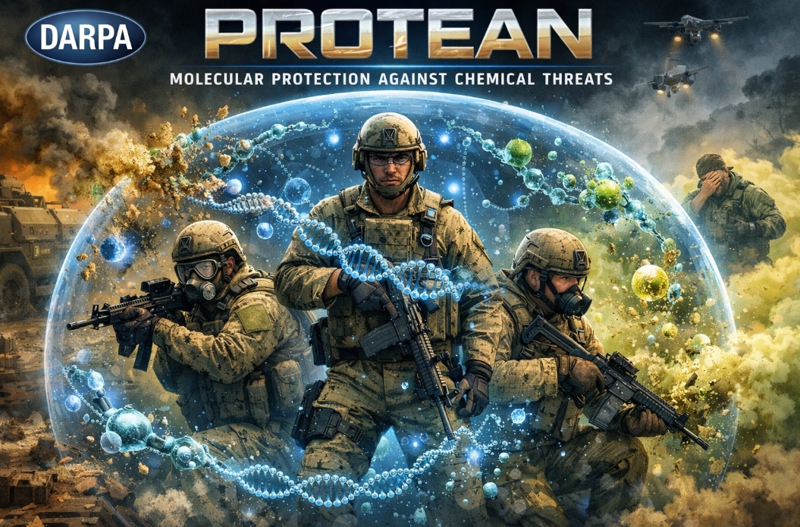


DARPA is putting together the Protean research program that would provide preventative protection against chemical threats at the molecular level.
The US Defense Advanced Research Projects Agency (DARPA) Protean program will initially focus on designing medical countermeasures (MCMs) across three specific chemical threat classes:
- Nerve Agents (eg. Sarin, VX, Tabun)
- Synthetic Opioids (eg. Fentanyl, Carfentanil, Remifentanil)
- Ion Channel Toxins (eg. Toxins from Scorpions, Snakes, and Spiders)
The idea is to design MCMs at the molecular level that would prevent these chemical agents from harming the human body when exposed, or at the very least, mitigate the harmful effects.
As the Protean program description puts it, “By rendering these traditional threats effectively non-toxic, each Protean countermeasure will enable the warfighter to achieve sustained operational readiness in contaminated environments.”
“Protean seeks to completely mitigate the negative health impacts of chemical agent exposure in current and future battlefields”
DARPA, Protean Program, January 2026
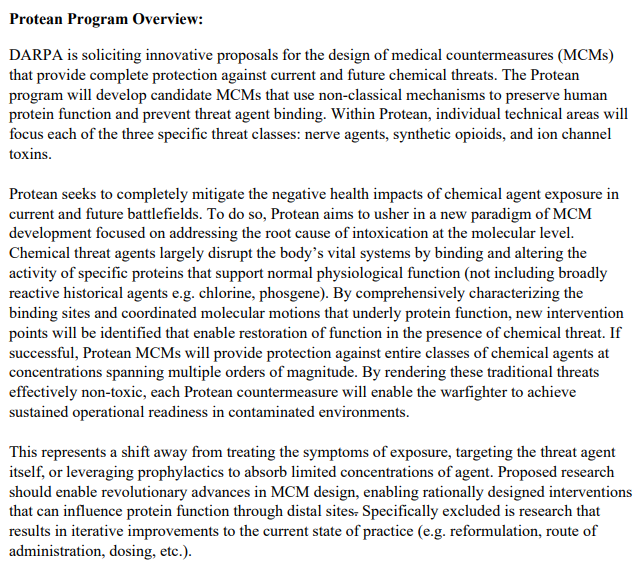
“The Protean program will develop candidate MCMs that use non-classical mechanisms to preserve human protein function and prevent threat agent binding”
DARPA, Protean Program, January 2026
Taking the lead on Protean is program manager Dr. Michael Feasel, who joined DARPA in 2022 after having served “in multiple toxicology roles at the US Army Combat Capabilities Development Command Chemical Biological Center,” according to his bio.
At DARPA, Dr. Feasel has led several research programs, including:
- Anesthetics for Battlefield Care (ABC): To develop safe, battlefield-ready anesthetics in order to reduce injury-associated trauma and improve combat casualty outcomes.
- Hermes: to overcome the challenges associated with broad, intracellular delivery of biologics to diverse cell and tissue types by developing new delivery modalities that provide systemic distribution with limited negative side effects.
- Rapid Inhibitor Discovery and Development pipeLine (RIDDL): To develop and demonstrate rapid methods to identify and optimize novel molecules that exhibit inhibitory effects on gene editing technologies.
“Protean aims to usher in a new paradigm of MCM development focused on addressing the root cause of intoxication at the molecular level”
DARPA, Protean Program, January 2026
Always a fan of wordplay, DARPA’s choice to call its latest program Protean is a peculiar one.
Protean is derived from Greek mythology and refers to the shape-shifting sea god Proteus.
A protean is someone or something that is versatile and able to play multiple roles or assume different forms.
And protean looks and sounds similar to protein, which DARPA is looking to manipulate.
According to the program description, “Chemical threat agents largely disrupt the body’s vital systems by binding and altering the activity of specific proteins that support normal physiological function (not including broadly reactive historical agents e.g. chlorine, phosgene).
“By comprehensively characterizing the binding sites and coordinated molecular motions that underly protein function, new intervention points will be identified that enable restoration of function in the presence of chemical threat.”
“If successful, Protean MCMs will provide protection against entire classes of chemical agents at concentrations spanning multiple orders of magnitude“
DARPA, Protean Program, January 2026
While DARPA is in the business of research and development for military purposes, many of its programs have made their way into commercial spaces.
For the private sector, Protean could potentially develop medical countermeasures to mitigate the effects of civilians overdosing on fentanyl before they used it or were exposed to it.
The same would go for people who live or venture into areas where venomous creatures like snakes, spiders, scorpions are commonplace.
DARPA will hold a proposers day for its Protean program on February 20, 2026.
The Pentagon’s research and development funding arm has long been in the business of human performance enhancement, advanced medical countermeasures, and programming biology. See below for more coverage.
Image Source: AI generated with ChatGPT