


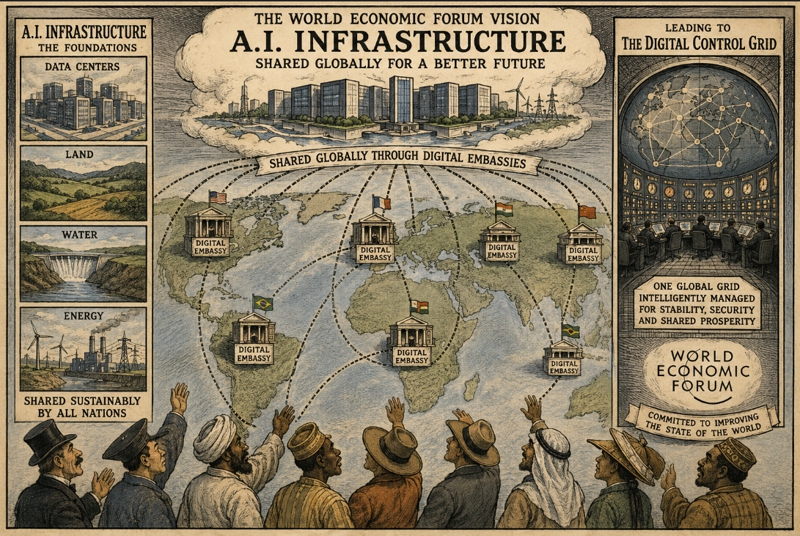


The infrastructure for the global digital control grid that was slowly being constructed over the past five years is now in the acceleration and implementation phase: perspective
There can be no globally shared AI infrastructure or digital embassies without giving data centers all the land, energy, and water they need, according to the World Economic Forum (WEF).
The plan is to build data centers in host countries that have all the money and resources to do so, and then allow other countries to access the AI infrastructure through what they call “digital embassies,” which grant them “AI sovereignty.”
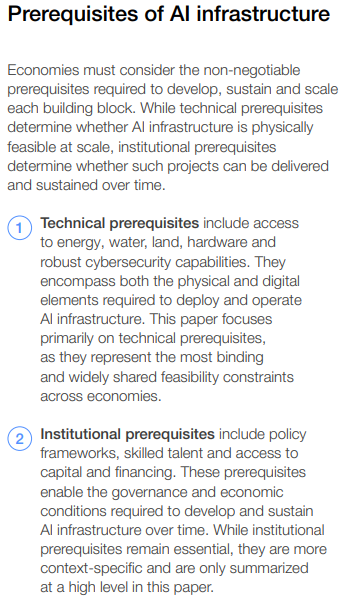
And when it comes to building AI infrastructure, there are two categories of prerequisites that are “non-negotiable” — technical and institutional, according to the WEF and Bain and Company report, “AI Infrastructure in the Age of Sovereignty: Requirements, Strategies and a Trusted Framework for Digital Embassies.”
On the institutional side, it’s about policy, talent, and financing.
For the technical side, it’s all about feeding data centers with enormous amounts of energy, water, and land — enough to sustain the needs of entire cities — while access to this AI infrastructure will move beyond borders.
“To develop these building blocks at scale, economies rely on a set of non-negotiable technical (energy, water, land, hardware, cybersecurity) and institutional (policy, talent, capital/financing) prerequisites”
WEF, AI Infrastructure in the Age of Sovereignty, May 2026
Once the AI infrastructure is built in the host countries, access is then given to other countries through what they call AI sovereignty.
According to the report, “AI sovereignty refers to the ability of economies to shape, deploy and govern AI ecosystems in accordance with their own values, while ensuring strategic and operational control, flexibility and, ultimately, resilience through a combination of localized investment and trusted international collaboration.”
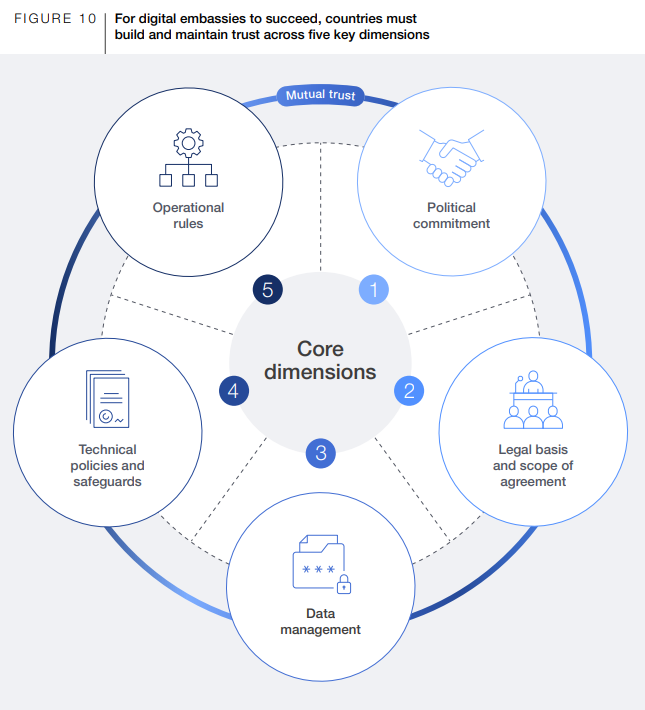
But in order to facilitate access to the AI infrastructure via their AI sovereignty, digital embassies are required.
Speaking at the WEF Annual Meeting in Davos in January, 2026, managing director Cathy Li made it quite clear that some countries should build and host the AI infrastructure while other countries should have sovereign access to it.
“As countries race to secure access to data, compute, and cloud infrastructure, it is becoming increasingly clear that not all the nations can or should build the AI infrastructure within their own borders […] Digital embassies enable countries to extend critical digital infrastructure beyond their borders while retaining control over data, compute, and governance”
Cathy Li, WEF Annual Meeting, January 2026
“AI is now central to economic competitiveness, national security, and public service delivery,” said Li.
“As countries race to secure access to data, compute, and cloud infrastructure, it is becoming increasingly clear that not all the nations can or should build the AI infrastructure within their own borders. This has brought the question of digital embassies and sovereign access to AI infrastructure to the forefront.”
“Digital embassies enable countries to extend critical digital infrastructure beyond their borders while retaining control over data, compute, and governance,” she added.
“When governed effectively, digital embassies can serve as a credible option for extending sovereign AI infrastructure beyond national borders”
WEF, AI Infrastructure in the Age of Sovereignty, May 2026
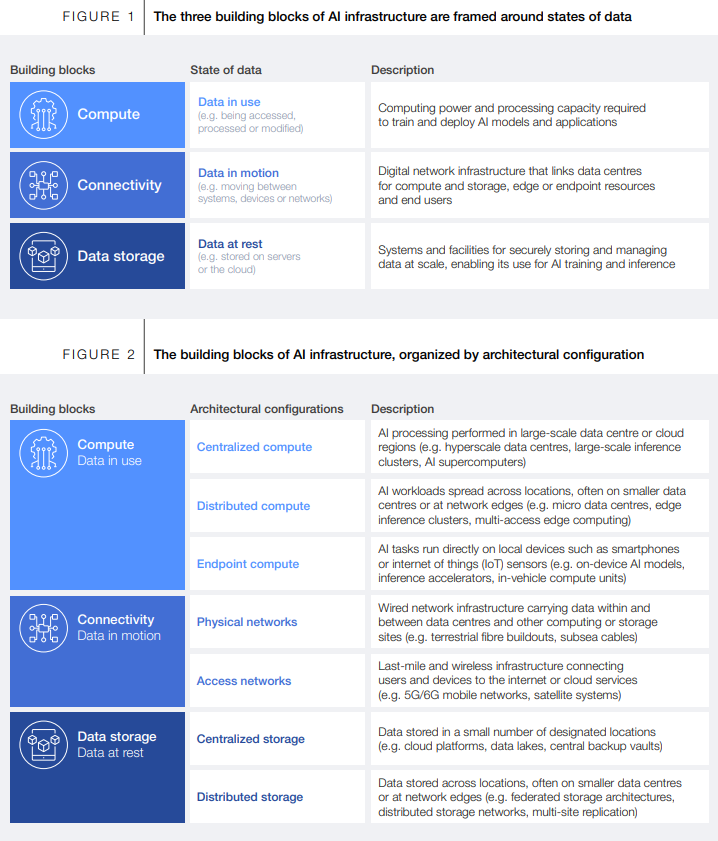
According to the WEF report, the non-negiotiable technical prerequisites for AI infrastructure include:
- Energy: AI infrastructure – especially data centers and accelerator clusters – requires large volumes of continuous power, and demand is growing faster than many grids can expand.
- Water: In many regions, cooling requirements make water a binding constraint for AI infrastructure. The largest AI-focused facilities may draw up to 5 million gallons (approximately 19 million liters) of water per day – comparable to the daily needs of a city of roughly 50,000 people.
- Land: AI-ready data centers require large sites with access to high-capacity power and fiber connectivity. A single AI training facility may require a minimum of 200 acres of land.
- Cybersecurity: As AI infrastructure becomes more distributed and critical to economic systems and starts hosting agentic workloads, it presents a larger attack surface and becomes a more attractive target. These risks are further amplified by AI-enabled threats, such as AIenabled social engineering tools.
The United States currently has over 3,000 operational data centers with another 1,500 in the works, according to the Pew Research Center’s figures from April, 2026.
These data centers are increasingly being built in prime agricultural land, and as we have seen, they require enormous amounts of water and energy to run.
“Today, digital embassies have resurfaced as a viable sovereign infrastructure option within the broader landscape of national AI infrastructure strategies. They expand the traditional notion of digital sovereignty – once tied to national borders and physical territories – by demonstrating how trusted shared arrangements can preserve control and governance over data and digital operations even when hosted abroad”
WEF, AI Infrastructure in the Age of Sovereignty, May 2026
As far as immediate benefits to the communities surrounding data centers, it appears as though there is very little.
However, when viewed from the lens of the WEF’s vision for AI infrastructure being shared across borders via AI sovereignty and digital embassies, it becomes more apparent than ever that access to these data centers will be used by governments and corporations worldwide to do with as they please.
And why are these massive data centers being built at such a grand scale?
In essence, they are for building a digital control grid where digital ID and programmable digital currencies restrict what information you are allowed to receive, what you are allowed to say, where you are allowed to go, what you are permitted to consume, and how you are able to transact.
This is called Digital Public Infrastructure (DPI), which consists of digital ID, fast payment systems like programmable digital currencies, and massive data exchanges between public and private entities.
Now, for DPI to fully realized, it needs the massive computing power that AI data centers provide.
The infrastructure for the global digital gulag that was slowly being constructed over the past five years is now in the acceleration and implementation phase.
WEF founder Klaus Schwab’s vision of the Fourth Industrial Revolution has morphed into what he now calls the Intelligent Age.
It’s all part of the great reset agenda to reshape society and the global economy.
Land, water, and energy use are now being prioritized to serve machines over people.
And as the machines get smarter, the humans get dumber and more reliant on the machines — along with those programming them — for their decisionmaking.
Image Source: AI generated with ChatGPT (oh! the irony)