


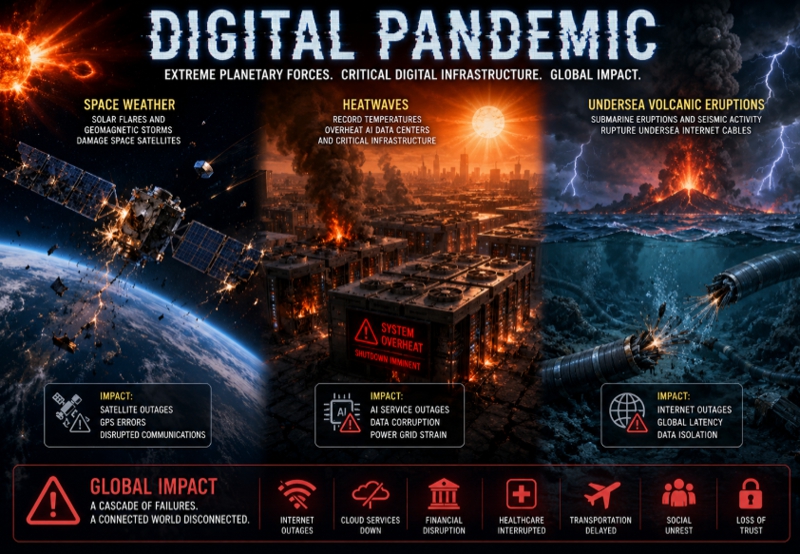


The ITU digital pandemic scenario is like the sequel to Cyber Polygon — prepping for a cyber pandemic that experts say is not a question of if, but when: perspective
“A digital pandemic is a plausible scenario,” according to a flagship report by the UN agency for digital tech — the International Telecommunication Union (ITU).
On Tuesday the ITU launched its flagship report, “When Digital Systems Fail: an expert report on the hidden risks of our digital world,” in collaboration with the United Nations Office For Disaster Risk Reduction (UNDRR), and the Sciences Po Paris School of International Affairs.
The report simulates various scenarios stemming from natural disasters that could lead to an all-out cyber pandemic where mobile phones and the internet stop working, payments fail, hospitals lose patient data, and emergency alerts never arrive.
“A large-scale, escalating failure of critical digital systems, a ‘digital pandemic,’ is a plausible scenario that current management frameworks are not yet designed to address”
ITU, “When Digital Systems Fail,” May 2026
While the World Economic Forum (WEF) and partners used to simulate cyberattacks in preparation for an inevitable cyber pandemic through their Cyber Polygon exercises, the ITU report looks at three naturally-occurring phenomena that could take down the physical infrastructure that forms the digital backbone of modern society.
The three scenarios include:
- Space Weather: Solar phenomena, including coronal mass ejections, solar flares, and geomagnetic storms that could damage electronic systems, disrupt communications, and induce dangerous currents in power grids
- Terrestrial Heatwaves: Prolonged droughts could affect the river systems used for data center cooling
- Undersea Volcanoes: Underwater eruptions that could damage submarine cables
The United Nations, the ITU, the WEF, the Gates Foundation, the Rockefeller Foundation, the Tony Blair Institute for Global Change, the G20, and so many other unelected globalist entities have been pushing countries to implement Digital Public Infrastructure (DPI) for years.
DPI is a civic technology stack consisting of three main components:
- Digital ID
- Fast Payment Systems (like programmable digital currencies)
- Massive Data Exchanges between public and private entities.
However, when combined, these technologies make up the foundation for a digital control grid where digital ID is required to access just about all life services while being connected to digital currencies that can be programmed to control what you purchase, what you sell, where can you make transactions, why, and for how long — and all that data is shared between governments and corporations.
On top of all the dystopian scenarios that DPI can bring, it is also extremely vulnerable to shocks and attacks, whether naturally occurring or maliciously manmade.
“While digital infrastructure has brought extraordinary efficiency, connectivity, and resilience to everyday life, it has also created new forms of systemic vulnerability”
ITU, “When Digital Systems Fail,” May 2026
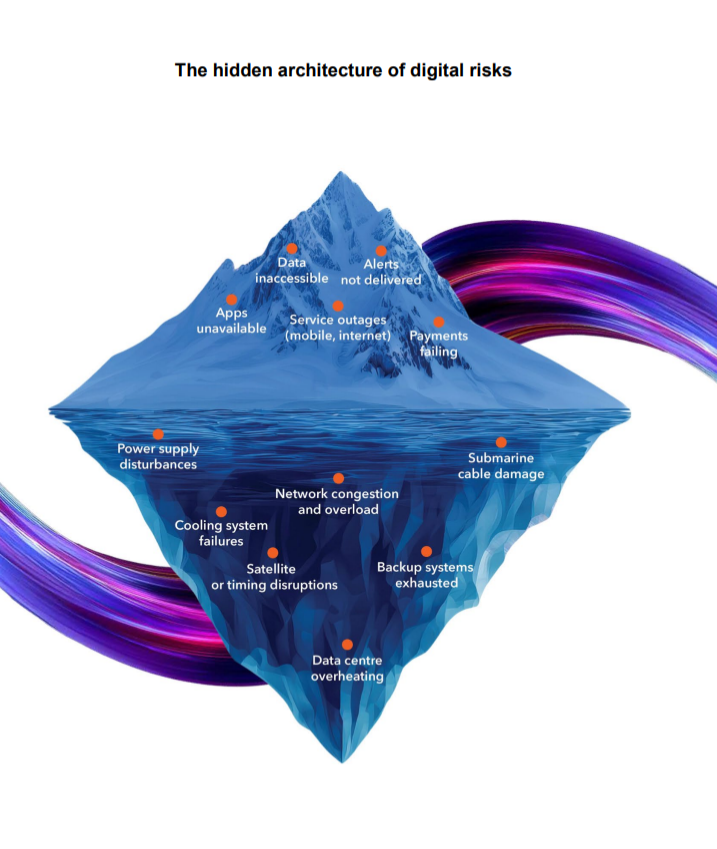
“Our ability to cope without digital systems has eroded. Across sectors, analogue skills and fallback options have disappeared or are no longer tested. When systems fail at scale, manual alternatives often cannot replace them”
ITU, “When Digital Systems Fail,” May 2026
With an almost complete dependency on digital systems and infrastructure, the analog world of yesteryear has been all but forgotten and lost.
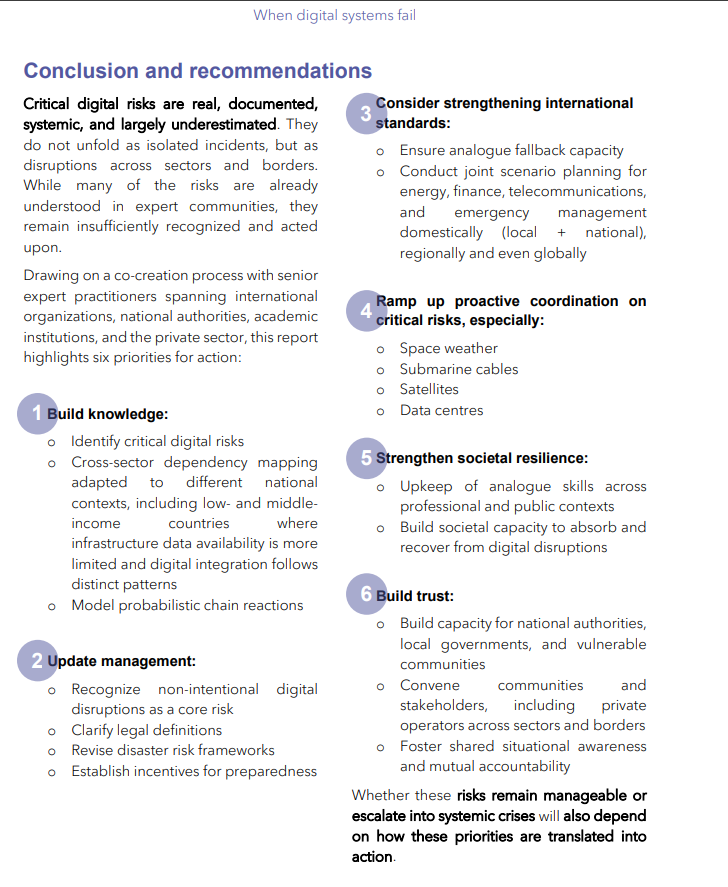
As such, the authors recommend that public and private entities “ensure analog fallback capacity” while maintaining an “upkeep of analog skills across professional and public contexts.”
Now, let’s take a look at what “the experts” have to say about the three scenarios that could lead to a digital pandemic, starting with space weather, then moving onto heatwaves, and undersea eruptions.
“Space weather is not integrated into national disaster risk registers in most countries”
ITU, “When Digital Systems Fail,” May 2026
On the topic of space weather, solar storms, space debris, and other extraterrestrial events could knock out satellites, communications, and power grids that grind societies to a halt.
For example, when it comes to space weather affecting digital finances, the authors remark, “Financial infrastructure does not merely use digital networks for transactions; it uses satellite timing to synchronize them. This timing failure is particularly consequential: When the timestamps become unreliable, clearing systems cannot determine the order of precedence. Transactions are rejected.”
Here are some of the examples of how space weather could lead to a digital pandemic with further knock-on effects, according to the scenarios in the ITU report:
- Aircraft must revert to fixed flight procedures rather than live radar
- Maritime navigation slows
- Autonomous cars stop
- Precision agriculture also halts, affecting food supply
- Hospital staff trained exclusively on electronic health record systems cannot locate patient information
- Bank branches without cash reserves cannot serve customers
- Traffic management in digitized urban centres fails
- Geomagnetically induced currents can cause transformer failures in national grids
- Data centres begin exhausting backup power
Moving from space and coming back down to earth, the next scenario in the report takes a look at what could happen to digital infrastructure in the event of an extended heatwave with prolonged drought.
“The heatwave is forecasted. The data center stress is measurable. The dependencies, power grid to cooling to cloud to health system to civil alert, have all been documented somewhere, by someone. What does not yet exist is a shared mechanism to view these dependencies together”
ITU, “When Digital Systems Fail,” May 2026
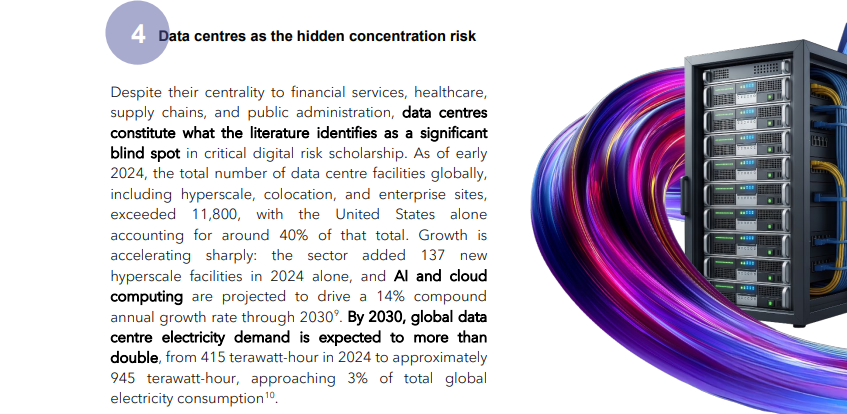
In the heatwave scenario, “The absence of a visible trigger, no explosion, no cyberattack, no dramatic failure, means that each organization waits for someone else to declare the crisis. By the time anyone does, the alert system that would have reached the public is already offline.”
On the ground, the result may look something like this:
- Mobile network latency increases by 180%
- Several thousand base stations lose active cooling
- A regional cloud provider suspends services and reroutes traffic to northern European nodes
- The national health authority’s patient data exchange system, used for real-time bed availability and ambulance routing, becomes inaccessible
- Emergency response times increase by 34% in the affected area
- A financial clearing system used by regional retailers fails to settle transactions for 19 hours
- Smaller merchants suspend electronic payments and close
- many shops are shut not because of the heat but because their card terminals cannot connect to a server that has overheated
- Radio and analogue systems are activated. Still, a significant proportion of the population does not receive the alert
Now that we’ve seen disaster scenarios for land and space, the last vulnerable environment mentioned in the report goes under the sea.
“Submarine cables carry over 99% of international internet traffic. Yet, there are only a few hundred globally. Repair capacity is commercially contracted and geographically limited”
ITU, “When Digital Systems Fail,” May 2026
The undersea scenario takes a look at what could happen in the event that a volcanic eruption ruptures submarine cables.
In this scenarios, “A generation of administrators, health workers, teachers, and traders who had never worked without digital connectivity discover, under stress, that analogue fallback requires skills that have been lost, equipment that has been decommissioned, and institutional memory that had not survived the transition to digital systems.”
Here’s how that simulation plays out, according to the report:
- Several cables are severed immediately. Others sustain damage that instruments will not detect
- Financial clearing for the region is suspended after 48 hours of degraded connectivity
- Businesses can not settle import payments
- Port operations slow by 60% as logistics software, dependent on cloud services, becomes inaccessible
- A regional central bank declares a connectivity emergency
- Health facilities that had migrated patient records to cloud platforms lose access to clinical histories
- The region reverts to operating on high-frequency radio and physical document transport
A basic theme running throughout all three scenarios of space, land, and sea is how the physical infrastructure — the satellites, the data centers, the internet cables — could all be taken out by natural disasters.
From there, financial services, medical services, transportation, communications, and everything else that relies on the internet is slowed to almost a complete halt.
At the same time, all of these scenarios could take place in the event of a deliberate attack, whether it be from an adversary or a false flag event.
“Cyber and non-intentional risks are increasingly interconnected: a physical disruption can create vulnerabilities that malicious actors exploit, while a cyberattack can trigger cascading physical failures”
ITU, “When Digital Systems Fail,” May 2026
“Misinformation spreads rapidly to fill the information vacuum. With verified information sources unavailable, speculations fill the vacuum. Rumors about the cause of the outage, about when connectivity would return, about which banks had cash reserves and which did not, circulate and are amplified. The information disruption is no longer a secondary effect of the cable rupture; it becomes a crisis of its own”
ITU, “When Digital Systems Fail,” May 2026
The solutions to any given crisis, whether real or perceived, are always the same: global problems require global solutions and global governance.
And what UN-aligned narrative would be complete without mentioning misinformation as “a crisis of its own?”
This is the same conclusion that was drawn at Cyber Polygon 2020 where BBC World News presenter Nik Gowing and veteran journalist Vladimir Pozner posited that fake news was a digital pandemic and that the average person of voting age was not capable of thinking critically for themselves and was more likely to swallow any information put out there than someone who went to a university.
The ITU’s digital pandemic scenario is like the sequel to Cyber Polygon — prepping for a cyber pandemic that experts say is not a question of if, but when.
According to the WEF, COVID-19 was known as an anticipated risk, and so is its digital equivalent.
What’s more, “A cyber attack with COVID-like characteristics would spread faster and farther than any biological virus. Its reproductive rate would be around 10 times greater than what we’ve experienced with the coronavirus.”
“A cyber attack with COVID-like characteristics would spread faster and farther than any biological virus”
World Economic Forum, A cyber-attack with COVID-like characteristics, January 2021
“We all know, but still pay insufficient attention to, the frightening scenario of a comprehensive cyber attack, which would bring a complete halt to the power supply, transportation, hospital services, our society as a whole”
Klaus Schwab, Cyber Polygon, July 2020
Whether it’s a cyber attack, a physical attack on infrastructure, or a natural disaster, the results would be the same.
What has changed in the six years since Cyber Polygon 2020 is the massive increase in AI data center construction and the enormous amount of electricity, land, and water needed to run them.
As unelected globalists push governments to adopt Digital Public Infrastructure worldwide, the need to protect data centers, power plants, and natural resources becomes paramount.
And what are they doing with these massive data centers?
In essence, they are building a digital control grid where digital ID and programmable digital currencies restrict what information you are allowed to receive, what you are allowed to say, where you are allowed to go, what you are permitted to consume, and how you are able to transact.
Image Source: AI generated with ChatGPT