





Digital embassies justify the resource-sucking, land-grabbing, energy-consuming, water-depleting construction of data centers for total surveillance & control: perspective
Digital embassies, where host countries build data centers in their citizens’ backyard for foreign nations to access, is a concept championed by the World Economic Forum (WEF), the Tony Blair Institute (TBI) for Global Change, and other unelected globalist entities.
Digging beneath the surface of the Orwellian doublespeak, we shall see that the primary function of digital embassies is to ensure that the global Digital Public Infrastructure (DPI) control grid remains operational and resilient to disruptions.
Right now, thousands of massive data centers are being constructed at great speed, but their primary purpose is not to serve the local communities from which they are sucking up resources like land, water, and energy.
No, these data centers are being built locally to provide foreign nations access to data and compute through digital embassies, so that the main components of DPI — digital ID, programmable fast payment systems, and massive data exchanges between public and private entities — can continue to track, trace, surveil, and control citizens digitally, wherever they may dwell.
A digital embassy is “a legally, technically and politically governed arrangement that allows states to preserve, restore or operate critical digital functions through trusted infrastructure beyond their territory,” according to the TBI insight report, “Digital Embassies and AI Sovereignty: Building Resilient States Beyond Borders,” published on May 28, 2026.
“As AI systems become more deeply embedded across government and the economy, states will depend not only on data and software, but also on cloud, compute, energy, connectivity, hardware and trusted providers that may sit beyond their territorial borders”
Tony Blair Institute, Digital Embassies and AI Sovereignty, May 2026
With protests and town hall meetings all taking place to oppose the construction of data centers in their backyards, many citizens are concerned about how they will be affected by the land, water, and energy required to maintain these enormous facilities — not just by the egregious amounts of resources they consume, but by their overall risings costs as well.
This is on top of the noise, light, and air pollution that comes with these centers and how these may affect home and property values, along with the types of contracts and tax exemptions that the big tech companies may receive.
And now, Wired is reporting that the US Department of Homeland Security (DHS) and the FBI are targeting concerned citizens who are opposed to AI data centers as anti-tech extremists.
“In California, Illinois, Indiana, New Jersey, Oklahoma, and Wisconsin, state and local police have removed or arrested speakers at town halls who criticize data centers, in one case before they were even allowed to speak,” Wired reports.
While local communities suffer from nearby data centers, the Blair Institute says they will be a positive boon for the national economies of the host states.
“For host states (those aiming to host such systems for other countries), they can attract investment, strengthen the economy, aggregate demand for cloud and compute, deepen strategic partnerships, and position countries within the emerging global digital and AI infrastructure ecosystem”
Tony Blair Institute, Digital Embassies and AI Sovereignty, May 2026
In general, hosts attract can attract many things: guests, partners, allies, customers, and events may all come to mind.
So, too do parasites.
Nevertheless, the alleged benefits to host countries are both economical and geopolitical.
As the TBI report states, “Ultimately, the decision to host one or more digital embassies will be driven by a mix of economic and geopolitical ambitions.“
Pay-to-play?
Are you a poor country that wants access to our data centers? You better go borrow some money from the IMF, or do as we say. Otherwise, you ain’t gettin’ that data and compute.
But to hell with the poor countries!
The TBI report recommends that digital embassies be first piloted among already established alliances like NATO.
The authors say that “Because digital embassies depend on legal reliability, political trust, operational cooperation and confidence under stress, it may make sense for states to begin within existing institutions, such as NATO, AUKUS or the EU, before broadening their resilience architecture.”
“Most countries are unable to fund or sustain the buildout of all the infrastructure they need to meet their own domestic compute demand – especially for frontier-model training. As a result, many governments will be reliant on external providers and this is why demand aggregation and trusted cross-border infrastructure could become attractive”
Tony Blair Institute, Digital Embassies and AI Sovereignty, May 2026
With all this reliance on host countries, the unelected, Fabian, socialist, globalists at the Tony Blair Institute claim that digital embassies will “Preserve Sovereign Control Through Interdependence.”
They say, “As the concept of digital embassies continues to gain traction, it will become an essential component of any country’s strategy for digital sovereignty, infrastructure access and technological capabilities.”
Interdependent sovereignty is an oxymoron.
In the context of the European Union, MCC Brussels visiting research fellow Norman Lewis said this week that:
“European ‘digital sovereignty’ is a grand delusion. It is delusional politically, because sovereignty belongs to sovereign nation-states and the EU is not one.
“It is delusional empirically, because no actor in the world – including the United States and China – possesses sovereignty across the full digital stack.”
The same concept applies to so-called AI sovereignty and digital embassies championed by the TBI and the WEF.
Digital embassies are all about making sure a guest state can continue to operate digitally by leeching off the resources of the host state, provided there are some tangible, agreed-upon political and economical interests.
One of the main goals is to ensure that the digital control grid known as Digital Public Infrastracture remains operational at all times.
In the TBI authors’ own words “At their most advanced, digital embassies are designed to preserve the operational capacity of the state – including identification, authentication, access to records, legal administrative processes and communication with citizens – even when domestic infrastructure or normal administration is disrupted.”
And there it is folks.
The core function of digital embassies is to ensure that the global digital control grid will always remain up-and-running.
All the thousands of data centers being constructed in prime agricultural land are for surveillance and economical and geopolitical clout.
“What makes the digital embassy model distinct is the combination of sovereign purpose, legal protection, trusted host arrangements, technical control, operational and political accountability”
Tony Blair Institute, Digital Embassies and AI Sovereignty, May 2026
As far as digital embassy rollouts are concerned, the Tony Blair Institute is true to its socialist, Fabian Society roots, slow-walking the process by calling for gradual steps toward their desired digital gulag.
According to the authors, “governments should proceed incrementally: starting with clearly defined use cases, testing arrangements under stress, and scaling only where demand, economics, legal protections and operational performance are credible.”
And yes, this is another step towards a type of multipolar control that supercedes any single nation — a type of interoperable world governance that will require “formal international rules” to maintain digital embassy continuity in the face of disruption:
“If a physical embassy is attacked, there are established diplomatic responses. If a digital system hosted abroad is disrupted, the line between a technical failure and a political act is less clear. This raises the question of whether more formal international rules are needed, rather than relying only on bilateral agreements.”
“Digital embassies […] can influence where critical infrastructure is located, which allies and partners a state relies on, and how states strengthen resilience, security and sovereignty in a globally interdependent system”
Tony Blair Institute, Digital Embassies and AI Sovereignty, May 2026
Diversification is the keyword here. They don’t want one host country to be dominant. They want a “globally interdependent system.”
According to the TBI report, “Relying on a single host, provider or regulatory system can shift rather than remove risk. Diversifying across locations can reduce physical exposure, but it introduces additional complexity and cost, along with new dependencies on host jurisdictions, local law, foreign providers, energy systems, and political relationships that may behave differently in times of crisis than in peacetime.”
Therefore, they say, “Systems should be capable of being moved, restored or reconstituted across environments to avoid the risk of being irreversibly dependent on a single host, provider, architecture or regulatory regime.”
Unelected globalists prefer an interoperable, multipolar structure, just as the WEF prognosticated back in 2016 with the publication of the video “8 Predictions for the World in 2030.”
The infamous phrase, “You’ll Own Nothing. And You’ll Be Happy,” was the first prediction.
But do you know what was the second prediction?
It was, “The US won’t be the world’s dominate superpower. A handful of countries will dominate.”
Welcome to the great reset!


The Tony Blair Institute report was published just 17 days after the WEF unveiled its own report on the same topic, entitled “AI Infrastructure in the Age of Sovereignty: Requirements, Strategies and a Trusted Framework for Digital Embassies,” which was published on May 11 in collaboration with Bain & Company.
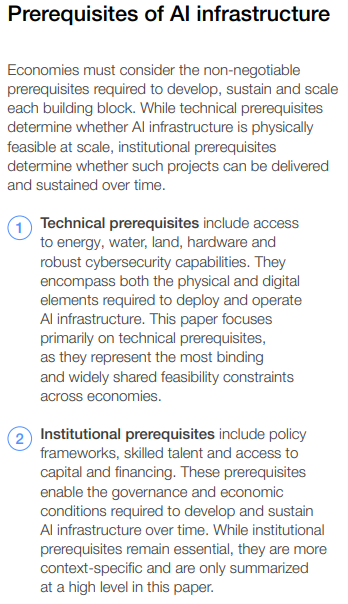
According to the WEF report, there are two “non-negotiable prerequisites” for the building of AI infrastructure — they are technical and institutional.
On the institutional side, it’s about policy, talent, and financing.
For the technical side, it’s all about feeding data centers with enormous amounts of energy, water, and land — enough to sustain the needs of entire cities — while access to this AI infrastructure will move beyond borders.
“To develop these building blocks at scale, economies rely on a set of non-negotiable technical (energy, water, land, hardware, cybersecurity) and institutional (policy, talent, capital/financing) prerequisites“
WEF, AI Infrastructure in the Age of Sovereignty, May 2026
“When governed effectively, digital embassies can serve as a credible option for extending sovereign AI infrastructure beyond national borders“
WEF, AI Infrastructure in the Age of Sovereignty, May 2026
There can be no globally shared AI infrastructure or digital embassies without giving data centers all the land, energy, and water they need.
The WEF and TBI reports are in lockstep with one another when they talk about needing digital embassies to preserve AI and digital sovereignty.
Just like the TBI report, the WEF report states:
“Today, digital embassies have resurfaced as a viable sovereign infrastructure option within the broader landscape of national AI infrastructure strategies. They expand the traditional notion of digital sovereignty – once tied to national borders and physical territories – by demonstrating how trusted shared arrangements can preserve control and governance over data and digital operations even when hosted abroad.”
War is peace.
Freedom is slavery.
Ignorance is strength.
Sovereignty through interdependence is the new Orwellian doublespeak.
But if you want to dig deeper into who else is behind the push for digital embassies, look no further than Abu Dhabi-based G42, which bills itself as “a unique technology group with a very human purpose, on a journey, to invent visionary artificial intelligence for a better everyday.”
“At its core, Digital Embassies and Greenshield treat sovereignty like a flag that travels with a workload, much like a diplomatic mission carries legal authority beyond borders”
G42, G42 Introduces Digital Embassies and Greenshield to Make AI Sovereignty Portable, January 2026
“As discussions with partner countries advance at the World Economic Forum in Davos and beyond, Digital Embassies and Greenshield, grounded in G42’s Intelligence Grid vision, are emerging as the de-facto model for sovereign AI deployment globally—ensuring that intelligence is powerful, secure, and equitably accessible wherever nations choose to build, compete, and collaborate”
G42, G42 Introduces Digital Embassies and Greenshield to Make AI Sovereignty Portable, January 2026
On January 20, 2026, G42 announced the launch of its “Digital Embassies Framework and Greenshield.”
According to the G42 announcement, “Historically, digital sovereignty depended on physical location. Data was considered sovereign because it was stored locally, and control required local infrastructure. Digital Embassies introduce a shift: sovereignty is treated as a legal and operational status that can be enforced consistently, even as infrastructure becomes more distributed.”
And voila! Digital embassies became a main stage topic at the WEF Annual Meeting in Davos that very day.
Speaking at that same WEF meeting, managing director Cathy Li made it quite clear that some countries should build and host the AI infrastructure while other countries should have sovereign access to it.
“As countries race to secure access to data, compute, and cloud infrastructure, it is becoming increasingly clear that not all the nations can or should build the AI infrastructure within their own borders […] Digital embassies enable countries to extend critical digital infrastructure beyond their borders while retaining control over data, compute, and governance”
Cathy Li, WEF Annual Meeting, January 2026
For unelected globalists, digital embassies justify the resource-sucking, land-grabbing, energy-consuming, and water-depleting construction of thousands of AI data centers.
With these data centers, they are building a global, digital gulag of total surveillance and control.
This digital control grid is to extend beyond sovereign borders, further dividing the geopolitical powers between rich and powerful nations and poor and underdeveloped states.
It is of my opinion that without intervention, this agenda won’t stop until everyone and everything in nature is tracked, traced, profiled, and catalogued by corporations and governments working in tandem through public-private partnerships that aim to supercede the sovereign authority of every State, every Consitution, every Republic, and every Kingdom on the planet, so that they all become fiefdoms of a new, stakeholder class of technocratic overlords.
Image Source: AI generated with ChatGPT