



World Models to train AI robots cracks the WEF Top 10 Emerging Technologies at this year’s Annual Meeting of the New Champions (AMNC), aka “Summer Davos,” in communist China.
Every year, the World Economic Forum (WEF) announces the release of its annual Top 10 Emerging Technologies with a press conference at the Summer Davos meeting.
This year, World Models made the list as being crucial for training AI robots how to operate in a three dimensional reality.
“World models could move AI from observing or simulating operations to actively informing decisions in real-world physical settings”
WEF, Top 10 Emerging Technologies, June 2026

According to the latest report, World Models “ingest data from multiple sensory channels at once – video, depth sensors, pressure readings, motion capture – and compress these inputs into a single shared representational space.”
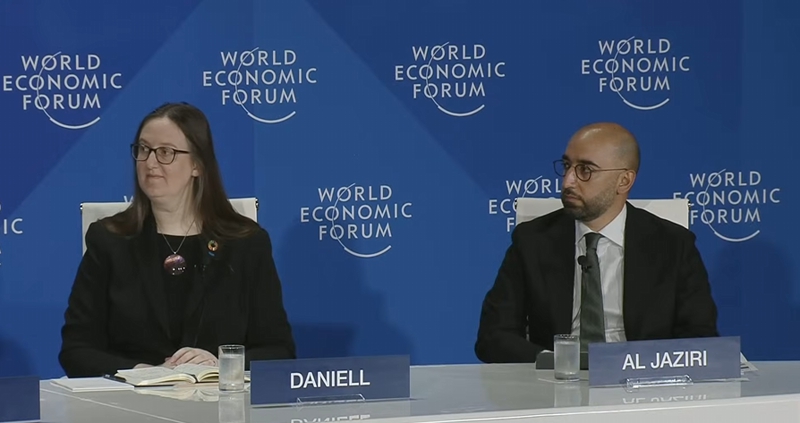
Speaking at the Summer Davos press conference on Tuesday, Australian National University School of Cybernetics director Katherine Daniell said that of all the emerging technologies listed in the report, World Models was the one that surprised her most — one that she said was going to keep her up at night.
“The one that surprised me most was World Models […] I think is the one that’s going to keep me up at night”
Katherine Daniell, WEF Annual Meeting of the New Champions, June 2026
“When I think of what it could mean to have AI learning in a different way, in an embodied structure, particularly around social robotics, how humans and machines are going to be working with each other particularly in those complex, or even chaotic environments, I think there’s a lot of opportunity there, but there’s also a lot of risk”
Katherine Daniell, WEF Annual Meeting of the New Champions, June 2026
“The one that surprised me the most was the World Models,” said Daniell.
“When I think of what it could mean to have AI learning in a different way, in an embodied structure, particularly around social robotics, how humans and machines are going to be working with each other particularly in those complex, or even chaotic environments, I think there’s a lot of opportunity there, but there’s also a lot of risk.
“The fact that these systems aren’t only working on the past data but are building worlds — simulated worlds at different levels of extraction — I think that’s a challenge that a lot of companies, communities, and governments haven’t necessarily thought through.
“We saw how quickly generative AI that was in the 2023 report came online, and so just thinking through what World Models mean as well, I think is the one that’s going to keep me up at night,” she added.
At the same press conference, Dubai Future Foundation deputy CEO Abdulaziz Al Jaziri commented that World Models will change how we perceive the way in which AI understands and interacts with our physical world.
“World Models really is a kind of AI that builds a simulation of reality across systems, and that really changes how we perceive how AI understands our physical world and how it interacts with our physical world”
Abdulaziz Al Jaziri, WEF Annual Meeting of the New Champions, June 2026
The need for World Models arises in part from the differences in which humans learn about the real world, and how AI systems learn.
The WEF report explores how babies can learn about gravity through experience without ever having acquired the language to describe it while LLMs can describe gravity in great detail but have no direct experience of it in any physical reality.
That’s where World Models come in.
“World models are designed to learn how the world behaves from data, drawing loose inspiration from how babies learn through experience”
WEF, Top 10 Emerging Technologies, June 2026
According to the report, “World models could move AI from observing or simulating operations to actively informing decisions in real-world physical settings. As that happens, organizations will need clearer ways to test, govern and hold these systems accountable.”
Then as the technology matures, “industries built on skilled physical judgement, including logistics, construction, manufacturing and elder care, could see their workforces change. The institutions that retrain and redeploy people as roles evolve will help determine how productivity gains are shared.”
Speaking of World Models and how scientists are attempting to train robots like baby humans, Atonaton founder Madelin Gannon spoke at Summer Davos on the same day during another session called, “Robots in Rhythm with Us,” in which she said, with regards to training robots: “purposeful play can be quite powerful when it’s open and intentional.”
Gannon told a story about giving her daughter a swing to play with, and how she thought she should do the same for a robot.
“Well, maybe my robot would like to feel outside of its body, too! It can move; it can swing itself, so I hung it from the rafters and let it have some playtime, too”
Madeline Gannon, WEF Annual Meeting of the New Champions, June 2026
As for now, one of the greatest risks in building World Models is the notion of garbage in, garbage out.
One flaw in the modelling about how the world behaves and the outcomes could be catastrophic.
After all, these World Models would serve as the basis of reality for soulless, non-living, machines making decisions autonomously.
“World models also introduce a different kind of risk: they may not only reproduce data bias, but also build flawed assumptions about how the world behaves. A model can be internally consistent and still wrong, creating blind spots when systems move from controlled environments into real-world settings”
WEF, Top 10 Emerging Technologies, June 2026
Imagine a robot caretaker looking after grandma, and in trying to move her, it grips down with all its might and crushes her bones.
The imagination can run wild with all the ways flawed models could produce devastating outcomes in AI and robotics.
This notion of World Models builds upon a similar theme from last year’s Summer Davos in China, which has to do with digital twins.
At the 2025 AMNC, it was revealed that in order to achieve true robot intelligence, a digital twin of the entire world would be required.
Giving a presentation last year on “Social Robots and I” University of Twente professor Vanessa Evers explained that it would be possible to train a robot like a Large Language Model (LLM), but it would require the creation of a complicated Large Behavioral Model that be like a digital twin of the entire world.
“For true robot intelligence, you need to build a model of the world, like a digital twin of the entire world”
Vanessa Evers, WEF Annual Meeting of the New Champions, June 2025
Evers acknowledged that we still have no idea how to create a digital twin of the entire world, but the process could start in smaller, closed environments like a classroom, a house, a factory, or a hospital and go from there.
Creating a digital twin of the entire world is an extremely complex undertaking that goes way beyond Large Language Models like ChatGPT.
In order to achieve true robot intelligence, a Large Behavioral Model would be needed to access and process enormous data from real world phenomena, which is far more complicated than creating and feeding Large Language Models.
Little-by-little, the entire world is being modeled, which may one day contribute to an ultimate digital twin of everything on earth and thus lead to “true robot intelligence” that can be specialized and purposed to perform any task, for good or ill.
Last year’s Summer Davos talked about needing digital twins for the entire world in order to achieve true robot intelligence.
This year, that idea came to make the Top 10 Emerging Technologies under the name of “World Models.”
This year’s 17th annual World Economic Forum Annual Meeting of the New Champions takes place from June 23-25 in communist China.
According to the AMNC overview, “The meeting will bring together leaders from business, government, civil society, academia, and the entrepreneurial community to explore how innovation and emerging technologies can unlock new growth models and drive positive economic momentum. It will also offer insights into the economic outlook of key emerging markets, with a particular focus on China and the broader Asian region.”
You can check out the WEF website for the entire list of panels and speakers.
Image Source: Screenshot of the Top 10 Emerging Technologies 2026 press conference at the WEF Annual Meeting of the New Champions in Dalian, China, June 23, 2025