




By 2030, AI agents could orchestrate up to $1 trillion USD in U.S. retail transactions. The payments industry has spent the last two years building the infrastructure to capture that moment, but the lending industry has largely spent it optimizing the branch.
That gap between where commerce is heading and where most lenders are looking is quietly becoming one of the most consequential strategic miscalculations in modern banking. Not because the lending industry is failing at what it does, but because what it does is increasingly happening somewhere it can’t reach.
The Plumbing Is Already Laid
The infrastructure for autonomous financial transactions wasn’t built in a lab somewhere; it was built by Visa, Mastercard and FIS – and it’s already live.
Citi and US Bank customers were among the first to access Mastercard’s agentic payments technology, with a global rollout already underway. Mastercard’s CEO, in fact, has called agent-led payments a “significant paradigm shift”, and the company has already partnered with OpenAI, Google, and Cloudflare to develop safety and authentication standards for autonomous transactions.
Meanwhile at Visa, Rubail Birwadker, the company’s SVP and head of growth products, declared 2026 as the year AI-agent payments go mainstream, pointing out that hundreds of agent-initiated transactions have already cleared in the real world.
This is thus not a roadmap; it’s a rollout.
Agentic payments are transactions where an AI system – acting on instructions a user gave it earlier – goes out and completes a purchase, compares financing options, or secures a loan without anyone lifting a finger; less ‘Siri setting a timer’ and more ‘your AI assistant just bought your flight, found you a payment plan, and submitted the application while you were in a meeting.’ The human sets the parameters, and the agent handles everything else.
The experimentation phase for this transformation is over. The scaling phase has begun, and most lenders are still debating whether to run a pilot.
The Numbers Behind the Shift
The scale of this transition is not evenly distributed across financial services. Payments have a head start, and lending is the category most exposed to being left behind.
An April 2026 report from ICSC and McKinsey found that 68% of U.S. consumers used at least one AI tool in the past three months as part of how they shop, and 62% said they’ve used the technology specifically to compare brands, models, prices, or reviews. Not early adopters, but mainstream consumers quietly outsourcing decisions that used to require deliberate effort – and getting comfortable doing it.
The logical next step in that progression is financing: if an AI agent can compare prices across a dozen retailers in seconds, it can compare loan terms across a dozen lenders just as easily – provided those lenders are readable.
That’s the part of the equation most banks haven’t solved for: the consumer appetite is there, the payment infrastructure is being built around it, and what’s missing is a lending layer that can actually participate.
What this means for credit discovery – for how borrowers find and choose lenders – is an open question. And the window to answer it won’t last indefinitely.
The Invisible Lender Problem
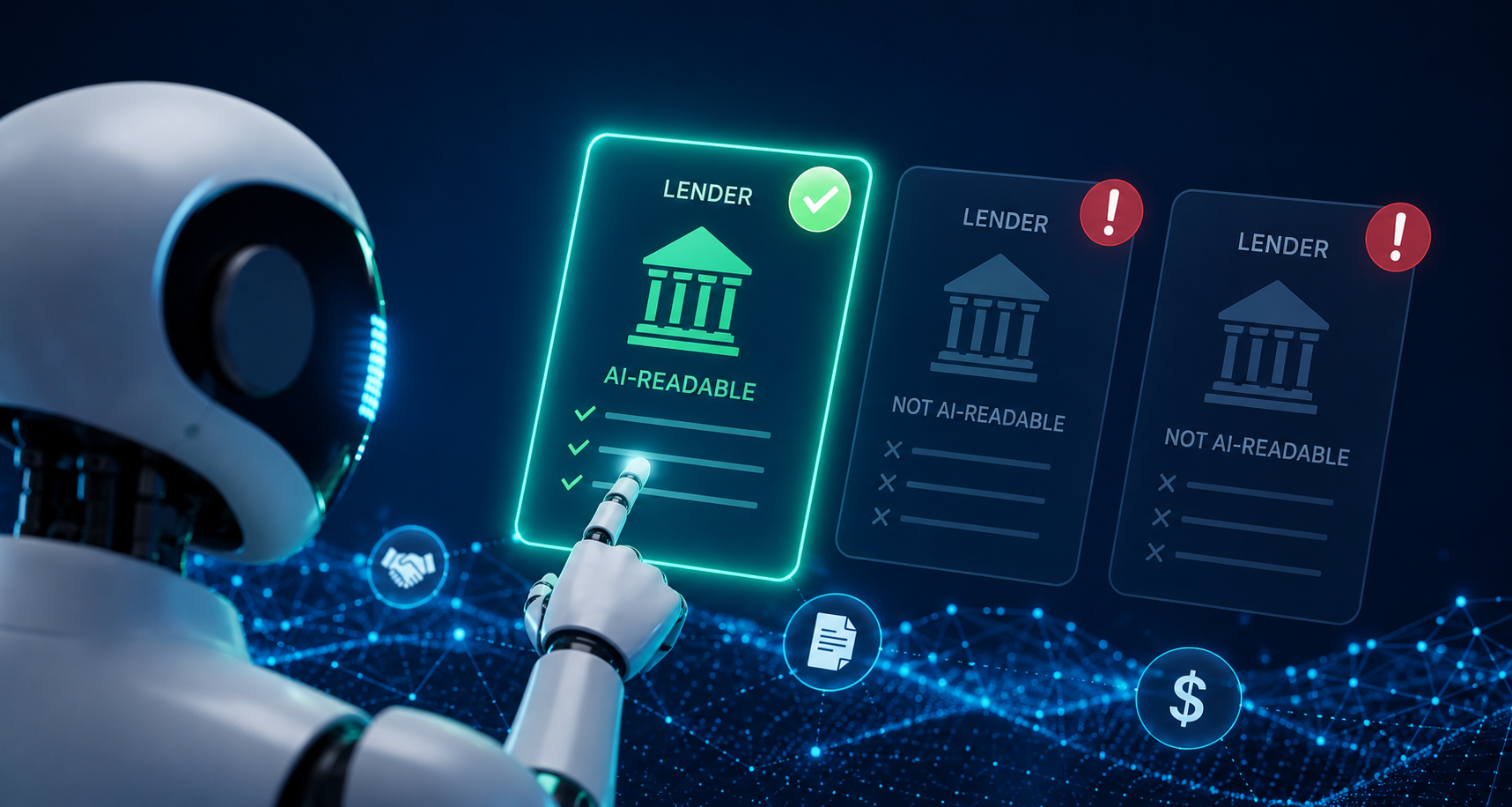
The broader financial industry has been slow to engage with a critical concern, Yaacov Martin, CEO of lending technology platform Jifiti, argues. When an AI agent goes looking for financing options on a customer’s behalf, it doesn’t browse bank websites or walk into a branch. Rather, it queries systems, reads structured machine-readable data, surfaces lenders whose infrastructure can actually talk back to it.
And most banks – built entirely for human borrowers navigating human-designed interfaces – simply don’t speak that language.
“For the first time in centuries, being a reputable, experienced lender isn’t enough,” Martin says.
The analogy is not new, either: it refers to the early internet. If your business wasn’t indexed by search engines in the late 1990s, it didn’t matter how good your product was. Customers couldn’t find you.
The same dynamic is playing out now – except the search engine is an AI agent and the product is a loan.
Large and mid-sized banks not adapting to this change will simply be routed around. The agent won’t penalize them; it will just not see them. And in a world where the agent is making the choice, invisibility and irrelevance are functionally the same thing.
This isn’t a fintech with lower rates or a neobank with a better app. It’s just a structural bypass where the entire discovery and decision-making process happens in a layer of technology most traditional lenders have no presence in – and no visibility within.
Where the Investment is Going: Is it Enough?
Most banks think they’re preparing for the AI moment. They’re running pilots, deploying machine learning in underwriting, using AI for fraud detection and customer service automation. By almost any measure, the industry is taking the technology seriously.
But there is a critical distinction between AI that improves what happens inside a bank and AI that determines whether a bank gets discovered at all. Banks that focus exclusively on internal improvements risk losing loan origination volume to agentic channels entirely – perfecting the inside of a funnel that customers are increasingly bypassing on the way in.
It’s the retail analogy all over again: a beautifully renovated store doesn’t help if nobody walks through the door anymore.
Over 90% of executives have considered introducing an agentic commerce tool, but fewer than 5% have a board-level strategy to actually do it. Knowing something is coming is not the same as being prepared for it.
The financial services sector alone is on track to spend $97 billion USD on AI by 2027, and much of that capital is flowing towards internal efficiency gains while the external distribution landscape is being restructured around them.
And Forrester predicts AI will automate more than a third of manual financial processes before the end of 2026 alone. That is the efficiency story.
The distribution story is a different conversation entirely, and it’s the one most boardrooms aren’t having.

Disclosure: This article mentions clients of an Espacio portfolio company.