


Our society is not new to paying for access. Renting homes, leasing office spaces, subscribing to newspapers and cable television — these have been part of everyday life for generations.
What is fairly recent is the scale at which the subscription model has crept into every aspect of modern life. Work, entertainment, communication, productivity, and financial services have all moved online.
As they did, customers have had to manage a growing list of recurring payments to keep accessing tools they rely on every day.
Subscriptions were sold as a convenient business model—a win-win for customers and providers alike.
The biggest benefit was the promise of instant access to a massive digital library or a suite of advanced features, in exchange for a small monthly or annual fee, rather than a massive upfront cost.
Over time, clients adjusted to paying recurring fees instead of owning a product outright. It created a system where access to services is no longer purchased once, but continuously rented. This arrangement hands ultimate control to the provider, not the client.
The Risks of Conditional Access
Losing access to a subscription service used to mean one thing: a missed payment. Today, access can be cut for reasons unrelated to billing.
From account suspensions to identity verification requirements and terms of service “black holes,” access is increasingly governed by a broader set of conditions than a monthly fee.
In 2023, Brandon Jackson’s Amazon smart home system was suddenly disabled after an Amazon delivery driver claimed he heard a racist remark through the smart doorbell.
Amazon later restored the account after investigating, but Jackson spent a week without access to the Echo devices running his home. He applauded Amazon’s need to protect its drivers, but called the shutdown unexpected and unwarranted.
In his words,”I question why my entire smart home system had to be rendered unusable during their internal investigation.”
The use of various subscription-based platforms to shut down political speech has also been widely reported.
In September 2020, Zoom unilaterally cancelled a San Francisco State University webinar featuring a Palestinian activist. Zoom cited US anti-terrorism laws, but the university maintained it had violated neither Zoom’s terms nor the law.
Such is reality in the rentier economy. Access is fleeting. It can be revoked over a terms of service dispute, algorithmic flaws or sudden updates.
Own Nothing, Rent Everything
This growing sense of exposure has contributed to what many analysts describe as “subscription fatigue” — a frustration with the sheer number of recurring payments required to participate in daily digital life.
Harvard Business School professor Elie Ofek argues that “the ubiquity of subscription offerings has led many customers to feel that ‘everything today is a subscription.’”
The appeal of subscriptions was convenience; a manageable monthly fee instead of one large purchase.
But small fees add up. A streaming service here, cloud storage there, a fitness app, and other small upgrades can quietly compound.
At a time when many households are grappling with inflation and stagnant wages, subscriptions add another layer of pressure, and these aren’t going away anytime soon.
It’s life for rent — a society where nothing is ever really yours.
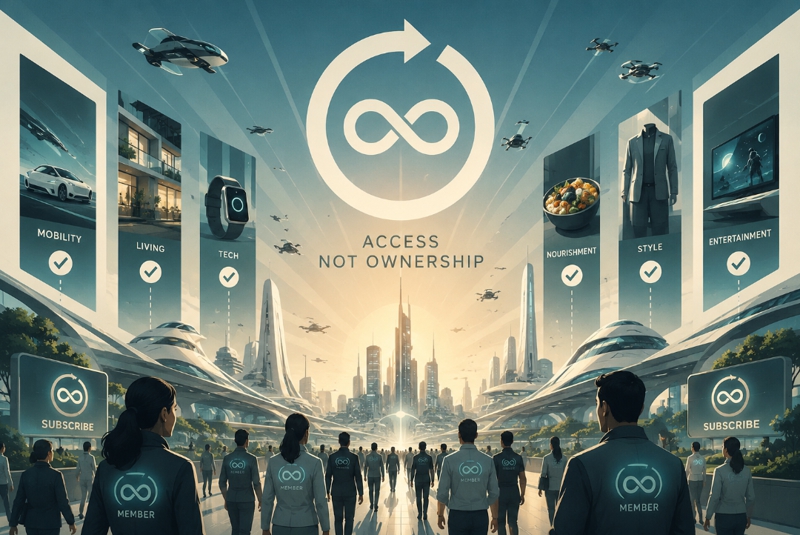
Image Source: AI generated with ChatGPT