





For decades, the immigration debate in American tech ran on a shared assumption: the U.S. held the opportunity, and the world’s best engineers would put up with almost anything to get to it. That assumption is breaking down. Foreign interest in U.S. jobs, measured by the share of job-ad clicks from other countries, has dropped 29% over the past year, and H-1B visa applications fell 38.5% in a single year. A court threw out the $100,000 H-1B fee in June, but by then it barely mattered. The people it was meant to deter had already started looking elsewhere.
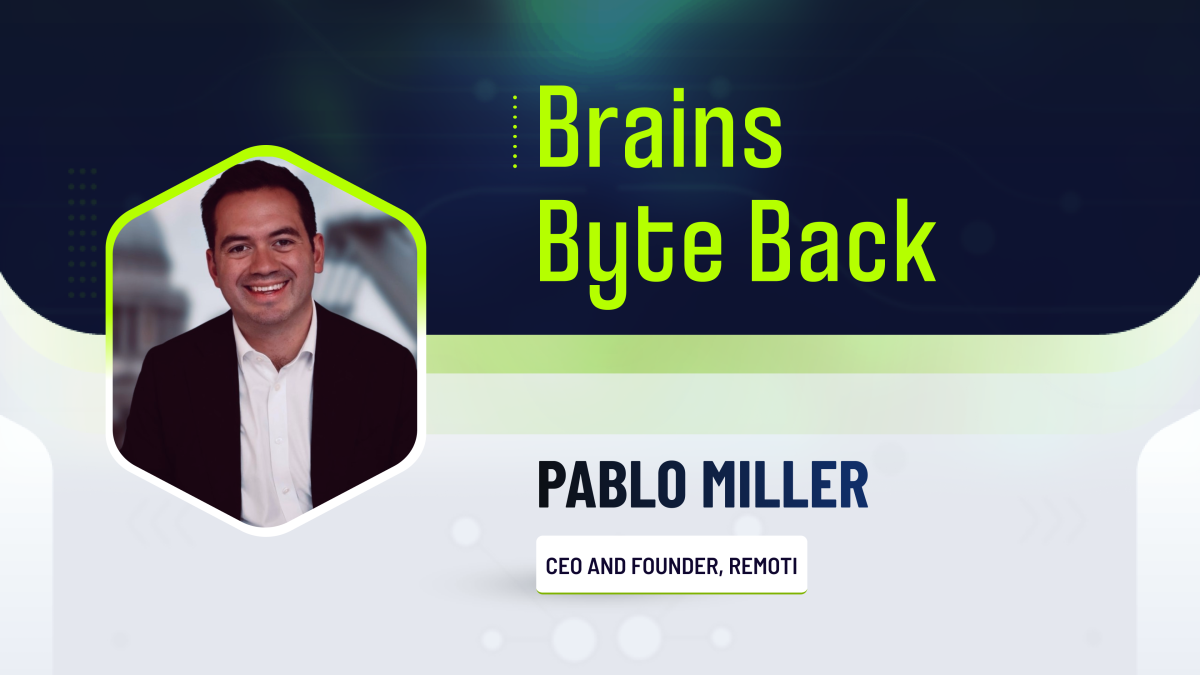
On this episode of Brains Byte Back, host Erick Espinosa talks with Pablo Miller, founder and CEO of Remoti, which builds and runs teams for international companies across Latin America. Miller’s whole business rests on a line he keeps returning to: talent is everywhere, opportunity isn’t. What’s changed, he argues, is that the opportunity has finally started traveling to the talent instead of the other way around.
He watched it happen from an unusual vantage point, his own flights home. Engineers who were meant to relocate to the U.S., Miller says, “were now starting to go to Latin America, to be on the same time zone as the U.S. colleagues,” where a visa was far easier to get. Washington tightened the border, and the talent changed its destination.
Not everyone wins. Miller is blunt that entry-level work is thinning, describing a “rush to become a mid-level engineer,” the tier that will end up directing the automation rather than being replaced by it.
But the center of his argument is that none of this reverses. The old bargain asked people to leave home to build a career. Miller’s bet is that it’s over: “If you’ve got the international opportunity coming to you, there’s no reason to leave.”
Find out more about Pablor Miller here.
Learn more about Remoti here.
Reach out to today’s host, Erick Espinosa – [email protected]
Get the latest on tech news – https://sociable.co/
Leave an iTunes review – https://rb.gy/ampk26
Follow us on your favourite podcast platform – https://link.chtbl.com/rN3x4ecY
Transcript:
Pablo Miller: Pablo Alfonso George Adrian Miller. It’s the most Colombian name mixed with the most English name. Really, what we do is work with European and US companies when they’ve identified a business function that they don’t necessarily need to have on-site, and they can look at having that business function in another region. The Remoti platform allows them to build these teams without having to take care of the recruitment, the payroll, the retention, and we’re able to turn that around very quickly.
On the B2C side, we built an app that allows local Latinos to save in US dollars, earn in US dollars, and have access to financial benefits as if they were a US employee. So folks are able to have pensions, life insurance, so they can stay here in Latin America while working for some of the biggest brands, and obviously contribute to the local economy.
Erick Espinosa: Amazing. Pablo, I want to start off by thanking you so much for joining me on this episode of Brains Byte Back. Like I mentioned before the record, I’m particularly interested in this topic, because that intersection between AI, tech, and recruiting is something a lot of people are talking about right now, but from different angles. I feel like this year, the story isn’t just how we’re building AI, but who gets to build it and where from. So you’re basically in that intersection, you work on how people get hired, how they find opportunity, and where people live.
But I want to branch this off from a story that hit the headlines that most people are familiar with: the H-1B visa. When that hit headlines last year, every global network was covering it, because they knew it was going to impact talent, and everybody had an opinion on what it would mean for tech employees and tech companies in the US. For people who aren’t familiar with what’s unfolded since then, at the beginning of June, a judge struck down the $100K fee for the visa. And that’s had some impacts, maybe psychologically and in approaches to how companies are recruiting. So why don’t we go off of that? It was good news for companies, but what do you think has changed, not just from this June announcement, but from when it was first announced they were going to try to implement this visa?
Pablo Miller: Yeah, sure. First of all, thank you so much for having me here. When we look at the exceptional C-level talent of corporate America in the tech space, it’s almost always immigrant CEOs at the moment. If we look at Microsoft, if we look at Apple, and what you’re seeing now is that the layers underneath need to be encouraged, as opposed to saying, “Look, you need visas, we’re going to make it harder for you.” What this shows is that yes, US companies can keep their identity as an American company, but they can be supplemented by foreign colleagues who come in and contribute to their organizations.
What I’m seeing is, I always look at who’s on the plane. When I fly back from the UK or the US, I started to see a lot of Indian folks coming to Colombia, and I was speaking to them on the plane. It was more that they were meant to be relocated to the US, and that wasn’t possible, so they were now starting to go to Latin America, to be in the same time zone as their US colleagues, and because here you’re able to get a visa much more easily. So I’m curious to see what will happen in the next couple of months.
Erick Espinosa: So in terms of LatAm specifically, you’ve been working in this field for quite some time. From what I understand, I read something about when you were 22 and you traveled to Bogotá. I know you’re originally from the UK, but your mom is Colombian. You went to Colombia, and something there clicked for you. What did you see that was missing in the recruitment world? Because this was happening before the pandemic, before AI was a thing.
Pablo Miller: Yeah, let me give you a quick overview. I actually set up my first recruitment company while at university in London. What we’d do is connect UK graduates to local fintechs, I was focused on hiring the best young people into these fintechs. When I came to Bogotá, I started meeting people my age, graduates, and a lot of them had studied abroad. I looked at them and thought, their English is amazing, they’ve worked for US companies before, and now they’re back in Bogotá and they want to stay home. Imagine if you could build a platform that allows them to stay here and work for companies outside. And imagine if you could do it the other way, the platform allows companies to seamlessly hire, onboard, and retain these folks. That’s really what made me stay here.
When I arrived, as you mentioned, this had been going on for ages, especially in the oil and gas sector, foreign companies hiring local talent. But what normally happened was it was big corporate jobs or software houses. It was never really a career where you could contribute to building an organization, growing it, they were just seen as “the other people down in Latin America.” That’s where I thought the recruitment side was broken. Because if you could allow local Latinos to be embedded into these organizations, as important as their US colleagues, you’re onto something. That was my mission then and still is today.
We’ve proven it now. We’ve got one example of one of the fastest-growing fintechs on the NASDAQ, they’ve got 70% of their workforce here in Colombia, and they serve US clients. I see the Colombia team embedded with the US team, the markets have enjoyed it, and the market cap has grown. So I’m very proud of that.
Erick Espinosa: During that time, when this idea first came about, you’re linking the talent with recruiters, were companies in the US really receptive? How easy was it to convince them this was a smart move?
Pablo Miller: I would almost say impossible. It was always, as they say here in Colombia, el visto bueno, the seal of approval. I had to find someone in the organization who had a connection to Latin America. Maybe people like you and me who have family here. And interestingly, I never sold on price. I was never like, “Look, it’s cheap.” It was more, “You’re going to find more connected employees.” There was a time in America when everyone was frustrated that there was no retention, people left after a while. So when I said, “Look, you’ll have very loyal, very grateful employees who’ve just been given the opportunity, they’ll work well”, people always think it was magic. It’s not magic.
The other one is also just luck. We were working with a local startup here, a payments company, and it got acquired by Visa. So then Visa became our client. Once you have these logos, it allows you to do it. Now, apart from my day-to-day job as CEO, I also lead new business. When you talk about Latin America now, they say, “Interesting, but I still want to take the risk.” When you explain that they can contract with a US company, we take care of the payouts, the HR situations, and the contracts, it doesn’t become such a complex sell. So now I’m starting to see that this kind of hiring is becoming normal.
Erick Espinosa: I’d imagine it was a technical thing too, because now you have the tools to make working from home a lot easier. With the pandemic, people were trying to figure out how to make this happen, and it just became natural. So when you approach people now, because of that cultural thing, it’s like they already have the tools to do it, because they already have people working from home. I imagine that was part of it as well.
Pablo Miller: The tools, exactly. We have a computer business that makes it easy. But what makes it super easy now is that we have second- and third-generation folks who started working for local companies that have US products. After the tech bubble burst post-pandemic, a lot of the people who’d been working with cool startups ended up working for corporate US companies locally. So now they understand what a fast-growing startup is and what a big corporate company is, and combining those produces candidates who are happy to deal with bureaucracy but also happy to move fast and break things. Once clients start to interview these profiles, they’re like, “We’re getting the best of both worlds.”
And as you mentioned, they all work remotely. The pandemic helped, but what I’m now starting to see is that these folks actually want to work together. One of the businesses we started is a coworking space, more like a center of excellence. From the ecosystem we have, we have an office where people from different companies come in and share information with each other. I always thought they wanted to work from home, they do, but would they want to spend one or two days together and learn best practices? Yes, they do.
Erick Espinosa: Would you agree, there are a lot of people… I spoke specifically to a friend of mine who works as an immigration lawyer. She tells me that when she tries to hire people in Canada, there’s a points-rate system, but a lot of people don’t realize that, especially in Colombia, there are a lot of people with two or three degrees. The talent pool here is massive in terms of education. And there’s a cultural aspect to that, which I’ve seen living in Colombia, people here are really dedicated to their jobs. They don’t bounce around from one to the other.
Pablo Miller: They don’t move too many jobs. Yeah, exactly.
Erick Espinosa: And I also noticed here, in Colombia there’s the most holidays.
Pablo Miller: I think it was double the amount. The two countries in the world with the most bank holidays are India and Colombia. Yeah.
Erick Espinosa: But the workdays are long. You get up at six here and the buses are already full. The traffic is insane because people are already on their way to work, they have long working days. That just shows their drive, which really impacts the quality of work.
Pablo Miller: It’s also because it’s a very family-oriented country. When we talk about the two or three degrees, it’s so ingrained in the culture. In the US and the UK, you kind of idealize dropouts if they do well. Here in Latin America, families want their kids to have the master’s, maybe live abroad for a year and do another master’s. That’s what families have always encouraged. But now what I’m seeing is, if the kid can demonstrate to their family, “Look, I’m working for one of the biggest companies in the world”, what do you mean, that’s better than the master’s?
When I arrived, I learned that to have certain C-level roles, you had to show you had certain master’s degrees, or you couldn’t even interview for them, which is the case where we’re from. But now, as long as you’ve got those logos on your CV, you can apply to these great jobs. And if you have that logo on your CV and you’re doing a job that should be done in the United States, the market value at some point will reflect that you’re a US-style employee. If I run product for a US company but I just happen to be here, with remote work, when I move on to another US company, I should be looked at like another US employee.
Erick Espinosa: What would you say in terms of talent here compared to other parts of the world?
Pablo Miller: There’s a great point you brought up that I didn’t finish. With one of our other clients, it’s really interesting when you talk about how educated they are, he had a rule that in order to interview, they needed a 4.0 GPA.
Erick Espinosa: But how do they do that in Colombia? The GPA thing feels so US, that’s very dominant there.
Pablo Miller: Yeah, there’s a local equivalent. But the point was: if you pass this GPA, for a lot of hardcore tech roles, it’s as if you’re as good as someone in the US. So we managed to find the 1% here. It’s unbelievable, because everyone talks about mid-level developers here, but that top 1%, when compared to their colleagues in the US, is incredible quality. And I interrupted you.
Erick Espinosa: No worries. Going off that point, there’s a line you said that I think is special. It hits strong: “Talent is everywhere, but opportunity isn’t.”
Pablo Miller: Absolutely.
Erick Espinosa: That speaks wonders. Getting more into it, how do you find the talent? I know that’s changed a lot recently. The talent is here. How do you find them specifically? Is it still the resumes? Because I feel like with headhunting right now, AI is a big aspect in terms of how you find them.
Pablo Miller: Two things. Number one, we’ve been doing this for 10 years, and we’re a large team of traditional recruiters here who take the time to interview them. We have a database of about 60,000, but these are pre-qualified digital, English-speaking professionals who have worked for US companies, based in Bogotá. That allows us to move quickly because we’ve got the database.
Secondly, we’ve slowly developed a brand. There are so many cowboys in this space who work with US companies, only use people as contractors for a couple of months of freelance work, then don’t pay them on time. I’ve made it very specific: to build trust in the region, I only want to work with the best companies from the US that are serious, not here just to do project-based work. So we actually have a large amount of inbound that comes through our app now.
Erick Espinosa: That’s important, the fact that you’ve built that 10 years of experience going into it. The newer companies trying to get into that AI recruiting world don’t necessarily have that as an advantage. It’s been coming up on my feed a lot, talking about how recruiters are going in and finding talent these days, because just handing in a resume nowadays isn’t enough.
Pablo Miller: No, exactly. What I find, opening up the AI question, is that AI, the tools we use internally, just make us more efficient. There are so many manual tasks in recruitment and interviewing, especially when you have a database like ours. The AI goes in, looks at the profiles, arranges calls with us. But one thing I’m adamant about is that AI won’t remove relationships. Number one, a US company saying, “Look, we’re not going to hire in Louisville, we’re going to hire in Bogotá”, I don’t think there’s going to be a bot that convinces the boardroom to do that. And number two, there comes a stage for a candidate where maybe they’re working for Ecopetrol and now they need to take a chance with a quirky US company. Would a bot convince them to leave a big corporate job for that? I don’t think so.
Now, as we’re in the age of AI, people are saying, “What’s going to happen? Is AI going to replace all these developers, replace all the programs you’re building here?” We’re seeing a massive drive right now in the US, the big tech companies with the forward-deployment engineer. These are the people who go into organizations, understand the processes, and then build out code to build automation. This is not done by junior developers, it’s done by mid-to-senior developers. So we’re now seeing massive demand for building automation processes in the US. And Colombia, given the number of mid-to-senior developers we already have who have already built automation programs, there’s higher demand than ever right now in the AI space to build these products.
Erick Espinosa: But do you also see what they’re being hired for shifting? I’m reading a lot about, and I did an episode on this, the “AI manager,” which is a broad term. People who’ve worked in creating the technology know how AI is implemented, but they’re more on the consulting side. They come in like a project manager, finding where the AI works, where it lives, and because they can navigate both languages, they can speak to people across all departments. The idea is to help the company pinpoint where the AI should be so the project doesn’t fail. Are you seeing more people look to fill that role?
Pablo Miller: That’s the role I just mentioned, the forward-deployment engineer. That role is the one most in demand at the moment. That person goes on-site, identifies which process can be automated, and then the actual code that builds the product is done down here.
Erick Espinosa: How about for young people? Is that a conversation you’re having at all?
Pablo Miller: It’s a great question. It’s tough. I’m starting to see fewer and fewer junior roles on the tech side. I say this to a lot of people, the young guys are like, “Should I still get into it?” And I’m like, absolutely, because if you get trained by these mid-level people now, the other guy is going to be building that automation and managing the agents. So right now, it’s a rush to become a mid-level engineer.
Erick Espinosa: It’s hard. A lot of people want to shift into the AI role and are trying to find where those opportunities are. It’s great that you’re stepping in and filling that gap, guiding people and connecting them with those opportunities in the US.
Pablo Miller: What’s interesting is that a lot of these AI companies, your ChatGPT, Anthropic, these are the chatbots answering questions. But now what you’re seeing with these companies is they need to make more revenue. Meta, Amazon, and now Palantir, this is why they call it the forward-deployment engineer, because they worked so much in the defense sector. They send the engineer in. To build this infrastructure, it all comes down to building automation, and all these big tech companies, in order to start commercializing AI, need this. That’s why I’m so excited about this opportunity for LatAm, because this automation is not being built by robots, it’s being built by people.
Erick Espinosa: When you say automation, are you talking about simple automated AI? Or how about the agentic AI sector, how do you see that?
Pablo Miller: Yeah. I don’t know if the ecosystems are quite ready for it. You’ve got amazing people in this world who have one leg in Silicon Valley and one leg here. But if we just stick to the automation, take Colombia, Colombia just becomes a factory to build automation. The talent’s there, we just need to bring the opportunity.
Erick Espinosa: I read something, you said more senior people are moving to LatAm to keep their big international jobs. That’s a real shift compared to people going from LatAm to the US or elsewhere, because they’re looking for where else there’s opportunity.
Pablo Miller: I’ll give you a case study. There was a startup, one of the guys came from NVIDIA, another from Grok. Because they’re just building a product, they don’t necessarily need the financing now, so they’re self-financing these projects. Because they’re self-financing, and because they don’t need to scale very quickly, they just need to build the product, they’re coming here to work with local talent so they can build it. Once their MVP is ready and they’ve got some traction, in terms of managing valuation, they’ll go to the market and start raising capital. So what I’m starting to see is these big AI folks who just need traditional engineers are self-financing products. And self-financing makes sense to hire here, the caliber of senior executives locally is unbelievable.
Erick Espinosa: Are you finding fewer people you speak to now are just happy to stay within Colombia? I imagine there’s a mix, that excitement to go live and travel abroad. But I also feel there’s a misconception, and I want to tread lightly here. A lot of people assume Colombians want to leave because there’s not enough opportunity. But that’s changing now. And I feel like a lot of people leave because they make the dollar, make some fast money, as much as they can. Sorry, can you hear me now? Did you lose the sound? Oh, you’re back.
Pablo Miller: Yeah, it’s a great question. I answer it like this. I was in London, and I’ve got friends, senior lawyers, bankers. You ask, how much money do you need to make to save 3,000, 4,000 pounds or dollars a month and keep up with living standards? It’s crazy, they don’t. They’re still using credit cards. These are guys making 150K, 180K a year. What’s happening to executives here, mid-to-senior people, is that once they reach a certain threshold, they live very comfortably, they can travel once a quarter, and they’re able to save so much money. So I’m seeing fewer people wanting to leave, they can suddenly start building a portfolio for themselves, invest. Because their earnings are in USD, they only convert what they need for monthly outgoings. Their savings, their future, is in US dollars. And when you’re able to save 60% of your salary, you start to consider: should you leave Colombia?
Erick Espinosa: Which is what our parents used to do back in the day. And now, because everything’s gotten more expensive, they say 30% of your monthly income should go toward rent. There are a lot of places in the world where that would be nice, but most people can’t hit that.
Pablo Miller: No, it’s impossible. Now, especially with the cost-of-living crisis, predominantly in the UK, and high taxes. There’s so much in the press about people leaving the UK. Here in Colombia, the cost of living is controlled, the quality of life is very good. The problem is opportunity. So if you’ve got the international opportunity coming to you, there’s no reason to leave.
Erick Espinosa: I think that point, quality of life, is really making a difference for a lot of people right now. I made the big move from Canada to Colombia. It was a big shift. I did it because my partners are from here. When people ask me, “Do you miss Canada?”, obviously there are things I miss, but for me the quality of life here is a lot better. And I’ve read a lot about how tech talent in Canada has been really hard to keep because of quality of life, and people are looking elsewhere. When tech talent is in demand, you have to do more than just offer a good salary. People need to understand where they’re living, and they need other incentives, because a lot of them come with their family, and they want to make sure they’ll be happy where they’re at.
Pablo Miller: It’s funny, I remember after the pandemic, US companies were like, “We’re hiring remote, we’re hiring in Canada.” That became the trend. And then in Canada, they looked at Latin America. But I feel like we need to get back into a culture of saving for the future, investing money well. It became normal to live off your credit card, normal to live paycheck to paycheck. If you’re able to live in a cost-efficient area where the quality of life is so good, not so far from your family that you can’t visit, but you work as if you were working for a US company in Silicon Valley or London, I think it’s an amazing opportunity that Colombia can give you.
Erick Espinosa: I 100% agree. I absolutely love it here. But I want to end on this.
Pablo Miller: You look very relaxed and excited.
Erick Espinosa: It’s funny, I had a friend visit me, and he said, “I don’t know what it’s done, Erick, but Colombia looks good on you.” And I was like, I know, look at my skin, it’s glowing down here. Look, I appreciate that. So, imagine someone’s listening right now and they can’t make a hire, they’re in the US. What’s the one move you’d tell them to try this month in terms of searching for talent down south?
Pablo Miller: Don’t overcomplicate it. Just get on a call, talk to someone, and get them to do a technical test, you’ll be amazed what they can do. And if you use a company like Remoti, which eliminates the risks of having to set up an entity, connecting you and paying this person, because if you’re hiring someone in the US, you know, we’re an LLC. So my advice is: if you’re struggling in the US to make a hire, just speak to someone in Latin America. When you realize they’ve worked for some of the biggest names in the US, that their English is great, and that they’re a lovely person with great values, it’s not that difficult to make that hire.
Erick Espinosa: There’s a reason a lot of companies are coming down here. If somebody listening right now wants to connect with you, get more insight on what you do, and how they could hire, how could they do that?
Pablo Miller: Number one, download the Remoti Global app, that gives you access to all the jobs we have. Number two, our website, www.remoti.io. And please connect with me on LinkedIn, Pablo Miller, I’ll always connect you with anyone on my team if you’re involved with that.
Disclosure: This article mentions a client of an Espacio portfolio company.