





Every hype cycle has a sales guy. Crypto had them with the bros selling coins that turned out to be worth nothing to buyers who mostly feared being late. AI agents have them now, and the pitch has the same shape: this is the thing, everyone’s adopting it, you’re falling behind. What’s actually changing hands, more often than not, is old automation and chatbots being sold as the latest in AI advancements. The practice has a name: agent washing.
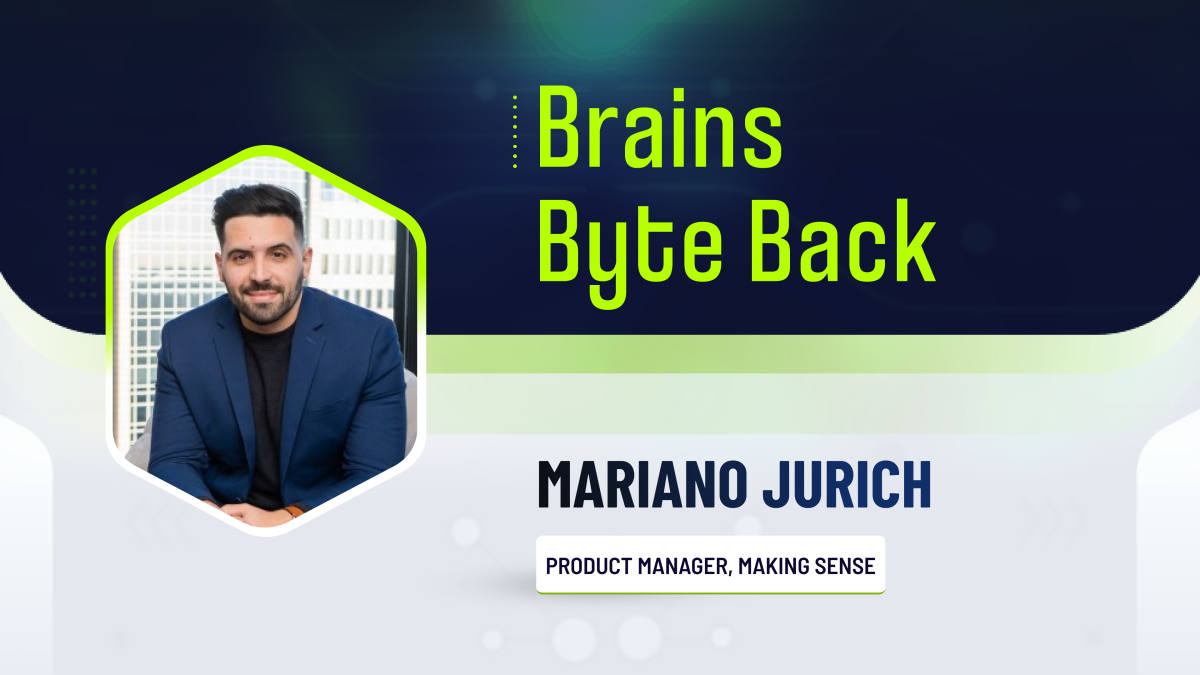
Gartner has attached a number to it, projecting that more than 40 percent of agentic AI projects will be cancelled by the end of 2027 due to escalating costs and inflated expectations. On this episode of Brains Byte Back, host Erick Espinosa sits down with Mariano Jurich, a senior product leader at Making Sense, who spends his days helping mid-market and PE-backed companies work out which parts of the AI pitch survive contact with a real workflow.
Nobody agrees on what an “agent” actually is
The trouble, Jurich suggests, begins long before anyone sits down for a demo, because the industry has never actually agreed on what an agent is in the first place. His own definition rests on four pillars. A genuine agent is autonomous, in the sense that it “doesn’t need you to be putting individual prompts to get to the goal that you’re expecting, but rather pursues the goal on its own”; it reasons and plans across scenarios rather than following a script; it reaches into the digital world through tools, APIs and code; and it learns from feedback, both its own and yours, delivered in plain English. Strip any one of those away and what you are looking at, however it has been branded, is probably automation wearing a new label.
The if-then-do test
Which raises the practical question every buyer eventually asks, and here Jurich offers a test that is almost disappointingly simple. “If you can describe what the tool does on an if-then-do type of sentence, then it’s probably not agentic 100 percent.” Predictable input, a fixed set of steps, the same outcome every time; that is a workflow automation, and, importantly, he is not saying that as an insult.
Much of his advice to clients runs in exactly the opposite direction of the hype, toward the unglamorous solution that happens to fit. Compliance validation and invoice consolidation are the examples he shares, cases where the rules never really change and where, in his words, “agentic is probably an overkill.”
The mistake he sees most often is not buying the wrong agent so much as starting from the solution and working backwards to a problem that did not need it. He is careful not to assume malice, either. “I don’t know if it’s bad intentions,” says Jurich, more a market pushing blindly toward whatever is latest and greatest, forgetting that the older tools still have a time and a place.
This isn’t a cloud migration
His sharper argument is about how companies are approaching this technology at all. Too many of them, Jurish says, are treating agentic AI the way they treated cloud migration, an IT-forward initiative, measured in reliability and scale, where you lift what you have, shift it, and optimize afterwards.
That framing quietly breaks down here, because embedding how an underwriter actually thinks into a system is a fundamentally different exercise than moving a server. “It’s very human-led,” he tells Espinosa, “because you need the people to be on board. You can get the best solution in the world, but if people don’t adopt it, it’s worth nothing.” He describes walking into companies that confidently map a process as A to B to C, only to talk to the people doing the job and discover it zigzags through half the alphabet.
What to put in writing before you sign
Jurich’s closing advice is about protecting yourself on paper before any of that becomes your problem. Define success before you sign, he urges, with KPIs at the 30- and 90-day marks written clearly enough that nobody can argue about them later, because these projects scale endlessly if you let them and there is always another feature to chase.
“Does it solve the problem? Does it deliver the business value that you’re expecting? Can you measure it?” Everything else, he suggests, is a rat race. AI, as he puts it, “is just another tool that you have in your toolbox to solve a problem. And that’s why it should be treated as such.”
Find out more about Mariano Jurich here.
Learn more about Making Sense here.
Reach out to today’s host, Erick Espinosa – [email protected]
Get the latest on tech news – https://sociable.co/
Leave an iTunes review – https://rb.gy/ampk26
Follow us on your favourite podcast platform – https://link.chtbl.com/rN3x4ecY
Transcript
Mariano Jurich
My name is Mariano Jurich. I’m a senior product leader at Making Sense. I work on the AI innovation department too. Basically, what I do is I help companies understand, define, design the best strategy to implement AI on their organizations. Amazing.
Erick Espinosa
Mariano, I want to thank you first off for joining me on this episode of Brains Byte Back and those of you who are listening. And today we’re going to be digging into something that I know has been happening for the last little while. But finally, it has a term and it was named recently by Gartner. And the term itself is called agent washing. For those of you that haven’t heard of it before, it’s basically this growing gap between what vendors are selling as an AI agent and what actually holds up once they try to put it to work. So basically think of it like a vendor rebranding old automation as new agents. And Mariano, I know that you work directly with mid market buyers. So they’re the ones that I think are most exposed to this. So we just kind of want to get some practical insight about basically what this looks like in terms of somebody just trying to put a fresh coat of paint on something that is basically automation. But I want to start by asking you, you’ve framed a lot of enterprise AI as basically plausible noise mistaken for real value. When every vendor right now is basically slapping autonomous agent, and I say this in quotations, on their product. What is actually driving that right now?
Mariano Jurich
Yeah, I think it’s a good question. And I think it goes a little bit behind that and is more towards can a company mutually agree in terms of what an agent is today? I feel like the term is used so broadly. And with all the advances that have been happening lately, especially on the Anthropic side, those guys have been releasing features like nonstop. And they’ve been pushing the ways in how things are done very rapidly. I think that it comes to first getting an agreement to what an agent is. And for me, and for the listeners, an agent is composed by mainly four things. It has to be autonomous. Mainly, that means that the agent doesn’t need you to be putting individual prompts to get to the goal that you’re expecting, but rather pursues the goal on its own. The second characteristic will be that it should reason and plan. Mainly, what I mean by that is the system should be able to think the different scenarios and then choose the most proper one based on the task that is being given. Then the third big difference is when you’re talking about agents and agentic AI, normally these systems have access to the digital real world. Mainly, they can interact with external systems. They can browse webs. They can run code. They can manipulate files. They can call APIs. They can integrate with different MCPs. There is a layer of access to the real world to make actions and to use the available tools that you provide to the agent that I think is also very relevant. Then the fourth one will be the capacity to learn and adapt. Normally, with an agent, there’s going to be two feedback loops. One, the agent is going to evaluate themselves and try to do better next time, but also you can give them active feedback on plain English, which is amazing. I think that’s what it defines agentic, if that makes sense. It’s been very mainstream. Mainly, I think it’s because agentic is associated with autonomous and autonomous is associated with less headcount. Every company that we’re working with, they are trying to get their agentic AI strategy in place. At the same time, I think people are, and I completely understand that. They’re a little bit behind in terms of what that means and how does it work. They ended up calling third-party vendors to help them figure that out. Some of those vendors have these pack solutions that end up being more like RPAs, robotic process automation, or workflow automations, rather than a pure agentic approach solution.
Erick Espinosa
It’s interesting that you say that because it makes me think of this video that I came across. I think it was on TikTok. The content creator, she basically described what’s going on right now like the crypto age, where you’ve got a bunch of guys that are crypto bros. They realize that this is a product that is really hot. People are interested in it. Then they’re selling you coins that really have no value. At the same time, there’s a lot of people trying to get into this market. It seems very saturated. A lot of people are like, hey, I’m going to fall behind. The sales tactic is I’m going to fall behind if I don’t have this in my workflow. You’re connecting with people that you see online or the algorithm that throws you this sales guy. They’re basically selling you a product that you don’t necessarily need. The way I see it is that it’s challenging because some of the people that are being tasked in these companies to find these solutions, I guess is the best way of saying it, aren’t necessarily well, have a lot of knowledge when it comes to AI and what is the best solution, especially because it’s growing so fast. How would you define what is the marketing tactic? Early on, before maybe getting into this demo or while you’re getting into the demo, how do you define they’re just trying to sell you something that maybe you don’t really need instead of it actually just being something that you actually need at the end of the day?
Mariano Jurich
Yeah, I don’t know if it’s bad intentions. I feel like it’s more a situation where many companies are pushing blindly towards AI and whatever is the latest and greatest to be implemented at the companies. Sometimes they forget that programmatic solutions or even workflow automations are still great options and they have a time and space and the solutions. Actually, many of the companies that I work with, we strongly suggest to go with workflow automations because the problem that they need to solve has a clear input, clear set of steps and a clear outcome and it’s always the same and never changes. So on those cases, a workflow automation approach is much, much better than an agentic AI approach. And you can think about, for instance, compliance validations, right? When you’re validating the same thing over and over again on different files, but the validations don’t necessarily change. That’s a great example. Invoice consolidation, for instance, that’s another great example for workflow automation where agentic is probably an overkill. And I will encourage companies to always think about the problem first and what they’re trying to solve. And I’ll give you two quick examples to represent this. If someone comes to us and tells us that they want to do an agentic solution for their employees to be able to check how many days of PTO do they have left, well, that’s for sure an overkill. I mean, that’s an API call. That’s all that it needs to be. It doesn’t need to be any more than a good polished programmatic solution. But now if the problem is different and it’s more complex, for instance, a business owner comes to us and says, hey, you know, I figured that during summer after the PTO, my employees are slow and sometimes they are sick because they get sunburned. So I want to give them tools to know exactly what type of sunscreen and how much should they apply depending on where they’re going. So now as you can see, this problem is much more complex because now you have the person itself. How much does he weigh? How high the person is? What time of the year are they traveling? What part of the world are they traveling? How many days? What is going to be the forecast on that place? How much exposure are they going to get into the sun? And, you know, there is all of these variables that makes the answer very complex to get to where if you try to put that in a programmatic way, it’s going to be very difficult, very, very complex. And if you put that on a workflow automation, it’s not going to work either because the variables are different. And what if the forecast service provider that we set up does not have the location because this person is going to go to a remote island in the middle of nowhere? So the workflow breaks. So you need the agentic capability to be able to solve that problem and, you know, continue towards the solution. That is a good example for an agentic solution, for instance. But again, it’s more about what is the problem that I’m trying to solve and what is the right solution to solve that problem and not over engineering. I think that’s that’s the main advice that I will give to the audience.
Erick Espinosa
And just to add on that, I think because one of the interesting things with the Gartner report is that they mentioned that about 40 percent of agentic AI projects will be canceled by the end of 2027. And that’s a mix of like because the costs are escalating because it could be very costly, obviously unclear business value. As more people are realizing that this is an issue, right, how are you kind of helping these mid-market businesses make sure that the types of solutions that they’re adopting would most likely be successful? Because I imagine people are seeing these numbers and their fear right now is that they’re going to be part of that 40 percent. And obviously they’re like, hey, we want to make sure that if we’re investing in this, that it’s going to add value in the long run.
Mariano Jurich
Yeah, I think that there are two parts of that. The first one is if there is something out of the shelf that solves your business, probably is a great idea to get it. Of course, you should do some research to make sure that the companies are not going to disappear tomorrow. Right. It’s not one of those thousand startups a day that we get an AI. But if there is something on the shelf that solves your problem, right, that’s going to be the most cost effective way of solving things. Now, if you if you need a custom solution because it’s, you know, a key part of your business or is very strictly related to how you perform business or how you deliver the service, then there are good practices that you can follow to control that. Cost of operation is a big thing that nobody thinks about. Like it’s like burning tokens pretty much. And there are a lot of things that you should do along the way while you implement these solutions to prepare for that and optimize it in the best way possible. So things such as running, you know, setting good parameters, access and controls and guardrails for the agencies is very important, but also having a good evaluation pipeline at the end of the process. So you can actually determine how how accurate are you being and how costly your prompts are being on the execution basis. And probably those concepts are things that people don’t think about when they think about these solutions. They think about like all the good things. So I’m going to do this and it’s going to do everything by itself. It’s going to solve all my problems and I’m going to be able to be much more efficient. But there is there is a cost associated with that that needs to be considered. And I feel that that’s where a good consulting firm could help you understand, define and design that solution correctly for your business.
Erick Espinosa
So, Mariano, I’m sorry to put you on the spot, but I’m going to ask you this. I guess a lot of the conversations that you have with, you know, the big companies right now, there was another report saying, and I’ve seen this for the past year, that companies that are kind of getting rid of staff and bringing on AI to take on these roles, that what’s going to happen is they’re going to backtrack. They’re going to go back and they’re going to rehire a lot of these people. What are these conversations that you’re having? Like, are they legit? Like, and I’m not saying name names here, but are you connecting with some companies that are being very honest with you from the get go to be like, hey, we’re looking to reduce overhead costs and things like that. And part of that is that we want to invest in agentic AI to take up most of these roles. Because I’m not sure what a lot of people are talking about is that right now it’s being inflated by the media. It’s kind of fear mongering in terms of what’s going on. But some reports say one thing and then the media says another. But because you’re talking directly with these companies, what’s your insight based on that?
Mariano Jurich
I think there is a little bit of everything. For sure, there is the more mindful approach where the conversation is more leaning towards, you know, there is this new technology and we don’t want to fall behind. So we want to, you know, just see how can we leverage this for our business, which is a much more healthier conversation than the one like I want to wipe out my whole operation tomorrow. And I want to just, you know, put agents to work for them. I think a good comparison is this is I feel like the error comes when companies treat this as a IT forward initiative. As it could be a cloud migration process, for instance, when in reality is completely different. And the main reason why it’s because, for instance, when we were on the cloud wave, everybody was moving from on premise to the cloud. The approach was a little bit simpler because it was like you leave what you have, you shift it to cloud and then you optimize it as much as you can. Right. And that all the discipline was measured in how reliable and scalable your infrastructure is. Back then, you didn’t need to understand how a person performs their daily task or how, let’s say, an underwriter think and then rethink that process to optimize it, to put it and embed all that knowledge on an agent, which is a completely different thing. Because it’s not IT led. It sounds weird, but for me, it’s like very human led because you need the people to be on board. You can get the best solution in the world, but if people don’t adopt it, it’s worth nothing. And then you need people to be on board and collaborate with you because many times we go in the company and they’re like, we want to optimize, you know, or automate this workflow. And the workflow is A, B, and C, and then you get D. And you’re like, good. Okay. And then you go, you talk with people and then people are like, yeah, that’s not how it works. I mean, you go from A to C and then from C to Y and then you get to B, but then you go to B1 and then you get to C, but then you got to go to M2 and then you get to, you know, D at the end of the day. So the workflow is completely different. The knowledge is completely different. And all of that knowledge needs to be embedded on the solution. And I think that that’s the biggest challenge and the difference between cloud modernization and agentic AI solutions. And that’s one of the reasons why companies shouldn’t approach it as a completely IT initiative at the forefront.
Erick Espinosa
So I feel like that’s a great response, especially directly. I mean, speaking with the people directly that do the job, I think is what’s most important because that’s what provides you the most insight. But let’s get into how mid-market buyers basically protect themselves a little bit more. So I remember there’s this quote that was sent to me by you. So it was buy commodities, build differentiators. It can get tricky when every commodity is now sold as an agent. Right. I’m sure you’d agree. How do you draw that line for a client? Like what’s the red flag that exposes at first like a washed agent the fastest?
Mariano Jurich
Yeah, that’s my that’s my rule of thumb for building versus buying. Buy commodities, build differentiators. That’s a good time. It has a lot of caveats, but that’s like the big picture. Yeah, I think it’s again, I will suggest to either get someone that is knowledgeable in the technology or a good partner. But for the most part. If. If you can buy something out of the shelf and your competition can also buy the same thing out of the shelf and whether or not that is agentic, it still seems to be like a commodity for me. So you should be focusing more is on what the thing actually does. And I feel like if you can describe what the tool does on an if then do that type of sentence, then it’s probably not agentic 100 percent. So you should be asking questions such as, you know, what does this thing do? When does it do it? What is the outcome? How much is going to be the cost of operation afterwards? What’s the billing model for this tool? If you’re buying something out of the shelf and those things let you, you know, again, understand if this is something that is going to be able to pick up your problems and figure out a way out to the solution. Or if it’s more like a standard process, there is going to be some sort of like adapt to what your business does, like with tweaks here and there on the steps.
Erick Espinosa
Where would somebody start looking? Like most of the time you’re looking for something, you’re going to Google. Now people are going to go into like LLMs and chat. I need to find like, you know, like an engineering company that can help me with like software engineering company that can help me with this issue. But like, how do you recommend people really go about in finding a trusted partner to help them implement something into the workflow?
Mariano Jurich
Well, the easiest way is call us. That would be the easiest route. But aside from that, again, I feel like you should have some sort of, I mean, you got to be trained somehow on these technologies. Either you or someone at your organization, I completely disagree with the fact that some companies want to completely outsource this. There’s something that you should be part of your stack at somehow. Even if it’s one person in the organization that can make that judgment and ask the right questions whenever you’re having these introduction calls with these people. But again, if it looks like it’s, you know, A plus B, then C, then probably it’s not an agent. But still, if it solves your problem, that’s amazing. I mean, you should definitely go with that. Again, at this point in time, I will worry more about, does this solve my problem? And does this falls under my budget for cost of operation rather than if it is agentic or workflow automation or an RPA or, you know, whatever it is. At the end of the day, they are all, you know, AI technologies that serve a purpose. So I’m always focused on the problem. That’s the most important thing. That’s what’s going to get you, you know, the right solution. Don’t start from the solution backwards to the problem because you want it to be a fancy AI agentic solution when probably you don’t necessarily need that. Having a good understanding of the problem, I think, is how you prevent yourself to walk into something that you don’t need or it’s not a right fit for you. Of course.
Erick Espinosa
And I think it speaks to this last episode that I did where I was talking about the rise of the AI manager. Which is people basically in the companies right now that their role is to make sure that everything is, you know, going to plan. But they’re internal. Even though they’re working with people that could be like an external third party. Obviously, they have the company’s best interests in mind and making sure that, you know, everything from the guardrails, you know, recording their own forms of ROI. Right. Whichever way defining what that looks like. But I think that’s really important for people to kind of bring somebody on. And that’s an eye opening thing for people that are looking to get into this industry. Whether or not you’re straight up, you know, going into university or looking for a career change. You know, people that are kind of in the consulting world because it’s not. I mean, there’s a technical aspect of it, but at the same time, there’s things that you can learn along the way. And the technology is still growing. So they’ll be learning things as the technology itself grows.
Mariano Jurich
Yeah, of course. Of course. And I always tell people that don’t try to, you know, know everything and anything. It’s very hard. It’s very hard to keep up with with all the progress. But it’s good for you to at least understand how the technology works. Sometimes when I tell people that AI is something that gets text and return text, they look at me like, what are you talking about? But in reality, it’s just that. I mean, if you think about it is you put text, you get text back. With the agentic things it’s a little bit different because you have tools and they have external access to tools and things from the outside world. But it’s just that. Right. So having that into consideration, understanding that is probabilistic is not deterministic. Understanding what are the good practices to keep consumption down, understanding what are the good practices for getting the most consistent set of answers for all the problems that you’re making it since, again, it’s not deterministic how you make it, you know, as consistent as possible. I think those are the important things. And then understand very well how that maps out to business value directly. I mean, I think that that’s the most important thing. And many of those, I think, pilots you mentioned, I think those could be things that sound great on paper and they work amazing on the demo environment. With all that, you know, this structure predetermined data. But whenever you put them in the real world, you understand that they don’t bring, you know, as much business value as you expected at the beginning. And I feel like having someone that can understand at that level and ask the right questions to the right people. It’s it’s a great role to have in organizations right now.
Erick Espinosa
And maybe I want to leave this off on a note for somebody. Imagine somebody that’s listening to this podcast came across it because right now they’re looking for a new solution. Maybe they’re about to sign a contract. Knowing that they’re going to get into this. Is there anything specific that somebody should put on paper before they sign to kind of save themselves? Maybe when signing up with this company, whether or not it’s to be like, hey, this is something we’re going to try for a year. Like you advising these companies is like a consultant just to make sure, because I know some contracts can go longer. And obviously this is like a long term plan, but something that maybe somebody should have in mind, like as a takeaway.
Mariano Jurich
Yeah, I will highly recommend people to understand exactly why they’re trying to get out of the solution and set up some KPIs or goals on the 30, 90 days type of mark. So what I’m trying to say is make sure that you have in the contract a very clear way that cannot be doubt to determine if this implementation was successful or not for the business. I think that that’s very important because these things could scale a lot. There’s always new things to do. There’s always new features to implement. So you can, you know, get into that kind of like rat race, you know, behind new features and making it better and faster and more scalable and this and that. But in the reality, again, does it solve the problem? Does it deliver the business value that you’re expecting? Can you measure it? And can you say, yes, this was a success? No, this was not a success. I think that that’s what matters the most, aside from lines of code, aside from, you know, whatever else you get out of this. What is your definition of success for this implementation from the business standpoint? And remember that AI is just another tool that you have in your toolbox to solve a problem. And that’s why it should be treated as such.
Erick Espinosa
Those are very good points. Mariano, we’re reaching the end. I just wanted to thank you again. If anybody is looking to, I guess, pick your brain a little bit more, what’s the best way that they could reach out?
Mariano Jurich
Yeah, I mean, they can reach out me on LinkedIn or we can share my personal contact information. I’m always happy to discuss different points or be taught new things. So, yeah, open to both. Amazing.
Erick Espinosa
And best of luck to Argentina, because you are from Argentina. And you did mention that.
Mariano Jurich
So, yeah, yeah, yeah. So go, Messi. And yeah, hopefully, hopefully we’ll be winning the World Cup again.
Erick Espinosa
I hope Canada gets pretty far because they’ve done pretty well. Thanks again, Mariano. Thank you, Erick.
Disclosure: This article mentions a client of an Espacio portfolio company.