


In the latest episode of Brains Byte Back, host Erick Espinosa sits down with Dr. Nicolai Klemke, physicist, former rapper, and founder of neural frames, a Berlin-based platform that turns audio tracks into AI-generated music videos. A founder with the perfect mixture of drive, passion for creativity and analytical thinking that saw a niche and went for it.
The conversation kept circling a single big idea: AI isn’t just automating creativity, it’s expanding who gets to create at all.
A Visual Problem Hiding Inside Every Song
Klemke starts with a pain point every musician knows. “You finish a song, you’re super proud of it… and you want to post it somewhere. Like YouTube. But you need at least an image. You always need something visual. And that is actually like a big problem.”
That problem has only gotten bigger. Klemke pointed to a striking shift in listener behavior, that speaks to a modern way of finding new music. “I think there’s a statistic that 84% of Gen Z discover songs via short-form content nowadays, which is just insane.”
Visuals aren’t a nice-to-have anymore; rather, they’re the discovery layer. It’s the reason Spotify is doubling down on video, and the reason indie artists who once got by with a static cover image suddenly need motion.
Built for Musicians, And Those Looking to Flex Their Creativity
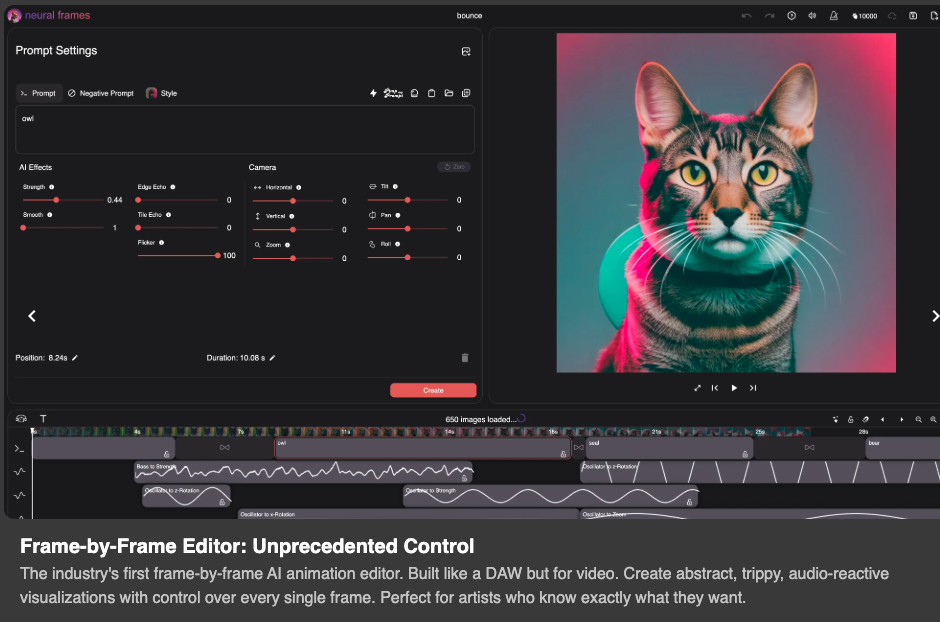
Where most AI video tools chase breadth, neural frames went narrow. Users have to upload a song before they can do anything else. “We don’t need to build the product for one million different types of people. We build it for one person,” Klemke explained. That focus shows up in the product itself: automatic lyric extraction, beat-matched cuts, and most importantly, character consistency stitched across the dozens of five-second clips that make up a typical music video.
Klemke and Espinosa address how his team keeps pace with the rolling updates in AI technology.
“I wish it was months, man. It’s more like days.” The filter Klemke uses to cut through the noise is always the same question: does this help our users make better music videos? If not, it’s a shiny object.
Creativity Over Monetization
Most neural frames users aren’t chasing virality — they’re indie artists, hobbyists, and people making birthday songs for their partners. “Many also say, you know what, this is so much fun. I’m enjoying this so much… It’s a hobby. And it’s cool,” Klemke said. “Ultimately, this is what AI tools do… it’s like enabling more people to create.”
In a market obsessed with scale, that might be the most genuine response from a founder— creating a tool that’s just giving people a creative outlet that wasn’t available before.
Find out more about Nicolai Klemke here.
Learn more about neural frames here.
Reach out to today’s host, Erick Espinosa – [email protected]
Leave an iTunes review – https://rb.gy/ampk26
Follow us on your favourite podcast platform – https://link.chtbl.com/rN3x4ecY
Transcript:
Nicolai Klemke
Hi, I’m Nico. I’m the founder and CEO of neurel frames, which is a platform to create music videos for musicians and artists.
Erick Espinosa
Nico, I’m so excited to have you on the show today. It’s great having you on to talk about creativity and content creation and AI technology. For me, that’s like my favorite intersection to talk about, obviously, because a lot of people that are watching us — that’s how they basically digest their information through content they find online, right? And right now, I feel like we’re crossing this line in the creative world where we’re not using just AI for algorithms. We’re basically using it as a creative tool for creative thinking. And it’s game changing for a lot of people because creatives who want to get into this world don’t have to lean on a whole production team. They have AI to lean on to help them do that. And it makes it a lot easier.
And you’re specifically in a niche where you’re helping artists — musicians that are looking to create content. But when it comes to AI and social media platforms and content creation, it’s become a little bit more nuanced. And I think platforms have kind of changed the economics of things from the way it existed maybe 10, 20, 30 years ago. And that keeps changing. So I want to dive into that with you. But before I get into that, I know you’re based in Berlin — is that correct? Which is awesome, because when I think of Berlin in Europe and music, that’s like the first city that comes to mind.
Nicolai Klemke
Yeah, absolutely. Berlin has many leading and very important music tech companies, such as SoundCloud. Many of the music production software companies come from Berlin — Ableton, Native Instruments. There’s, of course, the whole techno scene and the clubbing scene here. So yeah, it’s a good place for music. And it’s not the worst place for startups either.
Erick Espinosa
I mean, I’ve wanted to go for a super long time, mainly for the music. But I imagine for you specifically — because I know you started as a rapper and a physicist — is that correct? Yes. So what was the influence of Berlin? Because you grew up in Berlin, I imagine you were always kind of influenced by music to some degree.
Nicolai Klemke
So I grew up in Hamburg, which is the second largest city in Germany. And then I moved to Berlin to study physics, actually. And this was kind of very formative years for me, where I also was doing a lot of music, as you said, kind of as a rapper. Met many musician friends, and we had lots of gigs here. And yeah, the nightlife scene here is really good when you’re in your 20s, for sure. There’s lots to discover, lots to explore. I went on then to do my PhD in physics as well. So I got a bit more serious. And now, of course, there’s not so much nightlife anymore these days as a CEO.
Erick Espinosa
So when did you realize that you wanted to start NeuroFrames? I guess there was probably some sort of moment in your life where you’re like, hey, this is the direction I want to go.
Nicolai Klemke
Yeah. I mean, I was thinking of doing my own thing for a long time, to be honest. I was always kind of searching for the one thing that makes my life whole somehow, or gives me a place here on this earth. Like, I was doing physics and I was good at it, but it was never really my true passion. And so I was kind of looking for a way out with music. And also after physics, I did another job, which was cool, but also didn’t really feel right. And then I thought, man, I really want to try starting my own thing.
And that was a very good time, because it was 2022 and ChatGPT had just come out. Basically, like two days after ChatGPT had come out, I started building NeuroFrames. And I’m a physicist — I’m not a software developer — so there were a lot of things in web development I had no idea about. But I just started building. I played around with AI animation stuff that just came on the map with new AI models that were still very premature back then, of course. But I just fell in love with creating animations. And so I thought I cannot be the only one who enjoys this. And so I just built a product. To be honest, it was more of a project in the beginning. I didn’t know it would become a company. But here we are three years later now — eight employees here in Berlin and growing fast.
Erick Espinosa
So were you kind of like in your room, trying to create music videos for the songs that you were already making?
Nicolai Klemke
Yeah, I mean, you could say it like that romantically. Realistically, I was just playing with the tech. Because as a musician, you face this problem all the time — you finish a song, you’re super proud of it, and you want to post it somewhere. But already to post it on YouTube, just the song, you need some image at least. You need always something visual. And that is actually a big problem. I ended up at one point, pre-AI, drawing and making a video with stick figures — animating stick figures just to have something visual — and it was a lot of work. I was proud of it, kind of.
So yeah, and then with NeuroFrames, I saw the opportunity to niche down for musicians. Also early on, lots of musicians came to the site with the same problem: they needed visuals for their songs. So that worked out well.
Erick Espinosa
Yeah, I’m noticing that shift as well for Spotify. Because now that option for people to view the video is being accessed. I’m not sure if that’s available all around the world. But I know it’s something new that a lot of artists would want to utilize. Because capturing the attention visually is just as important as the music itself, I guess.
Nicolai Klemke
It is, actually. I think there’s a statistic that 84% of Gen Z discovers songs via short form content nowadays, which is just insane, right? So basically, people discover music on TikTok nowadays — that’s what it means. And of course, if you watch a video, it is kind of a more engaging listening experience than just listening to a song, usually, right? And this is why Spotify is also doubling down there. Spotify also sees a huge engagement boost. They’re very open about the statistics with visual content. And that’s why they’re going this direction.
Erick Espinosa
There’s a lot of products, a lot of tools out there. I think some people would argue that it’s a very saturated market when it comes to these tools available to make video and different types of content. What makes NeuroFrames stand out? I would imagine most people would probably go on ChatGPT or somewhere and ask for a tool they could use to create a music video.
Nicolai Klemke
Yeah, and there’s a pretty high chance that NeuroFrames will pop up there for sure. And I mean, we’ve been around — we’ve been one of the first companies that do this. And I think I’m proud to say that we’ve been leading the way in many product decisions, how to approach this problem.
You’re right, there are many companies now in this space. However, there actually aren’t that many with that particular use case. You see many companies that create AI videos, AI images, AI influencers, AI children’s stories — there’s a whole range of things you can do with AI content. And we are exclusively for musicians, or audio creators, as we call them. So the very first step on NeuroFrames is that you need to upload a song. Otherwise, you can’t really do much.
And I think this is cool. It gives us a certain angle in the product decisions we make, because we don’t need to build the product for one million different types of people — we build it for one person, or maybe two or three subgenres of the musician folks. So we can speak to musicians, we can build the features that musicians need and nobody else. And I think this is very beneficial for the product experience.
Erick Espinosa
How about for somebody like me? I saw this idea online recently because I’m trying to be creative with my partner’s birthday coming up. A lot of people do the song thing I’ve seen on social media. I’m not a singer, none of that. But I love the idea of creating something that has lyrics that are unique to us, that speak to our story. And I could go on a platform, create that song — show me how that would look on NeuroFrames. Because I would imagine I’d want that story to be told as an animation with two people that look like us. Is that possible?
Nicolai Klemke
Yeah, 100%. Thank you for giving me the opportunity to show off NeuroFrames. So basically, the first thing that you see — and by the way, this use case is amazing, Eric, because many people… it’s very interesting with AI music as well. There’s really a long tail of very interesting use cases in music and music visualization that didn’t exist before AI music, right? I mean, you might not have made a song as a birthday present for a friend before. But now you can — it’s super easy, it’s fun, it’s personal, it’s a cool present. And like this, there are many use cases, actually.
So you come to NeuroFrames, you upload your song. In this case, the song was called “Shadows in the Glow.” We extract the lyrics automatically from the song. We put a lot of effort into being extremely precise with the lyrics because they’re important for deciding what to show at the right time. We also do all kinds of audio analysis in the background that we don’t really surface to the user, because for us it’s extremely important that we understand everything we can about the song and what happens at which time — because yeah, it’s a music video, you want to show the right images at the right time.
And then you can basically pick a character, create one, upload yourself. You can type in a video concept, select a visual style, upload your own images as a style reference, which many people do. And then the next step is to come to a storyboard. In this case, I uploaded a character called Anna and basically typed in a story. Actually, you don’t even need to type in a story if you don’t want to — you can give the AI some guidance, but the AI will also come up with a cool storyline because it knows the song and understands it very well.
So here you have different scenes — just small depictions of how the video will look roughly. This is still very cheap to create, also fast. You can iterate on ideas, change different styles, try out different things. And ultimately, you come to the video page, basically the core, where we generate each clip. If you know AI video, it typically creates something like five-second clips. Now imagine you want to create a music video for three minutes — that’s 36 clips if they’re five seconds long. So we need to create 36 clips, actually more because we cut them to the beat and do all kinds of interesting stuff with it. And this is also our main IP — our magic sauce — how we keep the character consistent over such a long amount of time while also telling a compelling story. And then you end up with a video like this one.
Erick Espinosa
The realism is amazing.
Nicolai Klemke
And basically, you can then go ahead and edit each of these clips if you want to. You can also bring it into a timeline editor and go very deep in editing. Our approach is kind of low floor, high ceiling — easy to use, but also allowing you to go deep if you want to.
Erick Espinosa
This takes me back to the storyboard thing from drama class and how useful that is to tell a story. But to bring you back to this and guide you through it — for people that are familiar with something like that, it’s absolutely awesome. But you were also talking to me before we started recording about how fast everything is progressing. Do you feel like every couple of months there’s something you have to keep up with in terms of models? What’s the challenge there? Because you have a team that has to be focused on these new tools to keep up with the demand, I would imagine.
Nicolai Klemke
Yeah, I wish it was months, man. It’s more like days. There’s really so much new stuff happening in such a short amount of time. And it’s tricky, I’m going to be honest. I mean, it’s amazing, but also…
For instance, now we have character consistency, even multi-character consistency, right? And a year ago when we launched this product, we couldn’t dream of character consistency. It was just a sequence of clips and we tried to keep the characters consistent by prompting more or less the same thing for the models. Now we’ve figured out how to do character consistency really well. The models get better and better all the time.
But what helps us, I think, is the niche. There are many new developments in AI happening all the time, but in the end it always comes down to: does this help our users make better music videos? Yes or no? If yes, we try to find a way to implement it. If no, it seems to be a shiny new thing that might be cool to play with, but it’s not for us at the moment. So we constantly need to innovate around the workflow that we have, and maybe also throw it overboard at some point and build a new one. But it’s great — the videos are definitely benefiting from this progress.
Erick Espinosa
And what’s the reaction been? Have you worked with any specific artists that have had these videos kind of blow up alongside their music? Is there a distinct one that comes to mind?
Nicolai Klemke
We heard that the heavy metal band Satan — do you happen to know them? They’re actually quite famous, a Norwegian heavy metal band from the 80s. They’re really legends in the heavy metal scene. They made a NeuroFrames video, but that was already about a year and a half ago. To be honest, we’re more used by indie musicians, people like yourself who want to make a music video for a friend’s birthday, but also people who make their own music and then want to visualize it. We have had people that grew their YouTube accounts to 100,000 followers or so with the help of NeuroFrames videos — we see that constantly. But no big stars so far.
Erick Espinosa
Well, when you think about the story of SoundCloud, it’s artists that went on there to develop their own music and have this platform and reach that maybe they hadn’t had before. So I kind of see it in that way. And that story of it being from Berlin as well — there’s that connection, which I think is super valuable.
When you look at content creators right now and people that are in the music scene, there’s a struggle — because I looked up some stats and it says less than 5% of creators earn a full-time income from their content. In 2025, more than half earned less than $15,000. And when I was looking at the history of music videos, people earned more from music videos in the past — we’re talking when it was just MTV. But now we’re in this world of YouTube, Shorts, TikToks and things like that. And that’s where I understand most people are monetizing. So the smart play is using short clips from their music videos to reach an audience — potentially Gen Z — and then link that back to their YouTube page. And I feel that would be another way of monetizing.
Nicolai Klemke
Yeah, totally. Shorts is a big topic, and then link that to YouTube. Or what I’ve also seen is people running Meta ads in a nine-to-sixteen format video and then linking to their Spotify playlist, and then they monetize on Spotify. That also happens. There are definitely ways to monetize this by running ads in a smart way, but then it becomes a lot of work as well.
Erick Espinosa
I mean, there are different tools. You have to make those connections, right? You have to put in the work as well in terms of being a content creator in order to do that.
Nicolai Klemke
Yeah, 100%. And then the other side of it — I speak to so many users. For them, it’s more like, “Man, I just love that I’m able to do this.” Like, many would like to monetize this stuff, but many also say, “You know what, this is so much fun. I’m enjoying this so much. And I do see my follower count go up, and it’s a hobby and it’s cool.” I think ultimately this is what AI tools do — they enable more people to create, both music and video. And that’s just awesome to see.
Erick Espinosa
I agree. It’s a love that people have, a passion for some sort of art. I was that kid in my room just doing art because that’s what I enjoyed. And in some degree, some people make that into a career. But I think you have a good point in terms of it being a hobby and something that just makes them happy, even if it’s just a niche.
I’m seeing that when it comes to artists in the music scene, what’s really driving them is that fan base — even if it’s a small one. They’re monetizing through fans online and when they go to shows, because shows are still as big as they used to be, especially with Gen Z and Millennials. I kind of want to end on this note — I just wanted to ask you, because you’re in Europe, about the EU AI Act and the regulations coming into effect in August. Does any of that impact your approach to how you’re creating NeuroFrames?
Nicolai Klemke
It’s a great question, Eric. We are not training models ourselves yet. I think if we trained models, we’d have a much harder time. For us, I think we need to start labeling content in August, stuff like that. To be honest, nothing too bad from the AI Act for us. But of course, all of these things add friction that, if you ask me, wouldn’t necessarily need to be there yet — maybe in five years’ time when we’ve figured out what AI is actually being used for. I think the EU has its issues with regulating things a bit too early, maybe. But for us, we’re good.
Erick Espinosa
Yeah, I would agree. It’s complicated, right? Anytime something new in terms of technology is making some sort of shift, there are a lot of things people are trying to control and safeguard. I think it’s super nuanced. But we’re going to see how this develops, because after August we’re going to see what types of changes happen and how things are impacted. We want to make sure it’s benefiting people at the same time as it’s safeguarding them. But that’s the way I see it.
Nicolai Klemke
The world is relying on the EU to fix the AI problems.
Erick Espinosa
That’s a good point. Everybody’s looking to see what’s going to happen next. Nico, thank you so much for joining me on this episode of Brains Byte Back. If anybody’s interested and wants to reach out to you directly about accessing the tool, what’s the best way they could reach out?
Nicolai Klemke
Sure. You can hit me up on X — Nicolai Klemke, just first name, last name. And then of course, check out neuroframes.com. We also have a great Discord server where you can come to neuroframes.com/discord and talk to us. Yeah, looking forward to hearing what people think.
Erick Espinosa
Sounds great. Thanks a lot!