

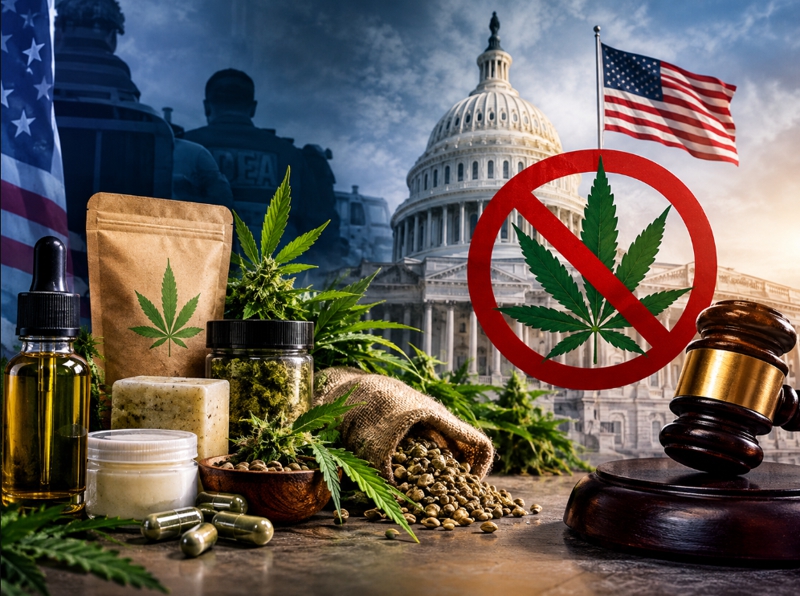


With the US Federal Hemp Ban set to take effect December 11, growers, manufacturers, mom and pop shop distributors, and insurance brokers alike are working diligently to navigate this chaotic space.
When Congress passed the Farm Bill in 2018, it amended the Controlled Substances Act (CSA) definition of marijuana to exclude hemp, making it legal to grow and sell hemp in the United States.
However, a “loophole” was quickly discovered where the definition of hemp was interpreted to mean that “products containing 0.3% delta-9 THC or less, and that may contain significant amounts of other psychoactive compounds, would not be considered marijuana and would legally be considered hemp.”
A $29 billion industry arose for “products marketed as hemp that contain cannabinoids other than delta-9 THC, such as delta-8 THC. These products are sold in a variety of formats (e.g., gummies, drinks, candies).”
Now that the ban is set for December 11, about 95 percent of those products will become federally illegal overnight.
To find out more about how the Federal Hemp Ban affects businesses, customers, and insurance companies, The Sociable spoke with AlphaRoot senior client manager Griffin Basden.
AlphaRoot is an insurance brokerage that guides cannabis companies through unique industry risks.
Basden says that when the Federal Hemp Ban was first announced about a year ago, carriers and brokers weren’t too worried.
At the time, they mostly assumed that a bill to kill a $29 billion industry affecting some 300,000 jobs would surely be fought and defeated.
But with the deadline quickly approaching, Basden says that her work has become “quite chaotic.”
“I worry about the timing with it; I worry about mom and pop shops, and I worry about the consumer because I really think this is hurting top-down everybody”
Griffin Basden, AlphaRoot, October 2026
Some small businesses are scaling back on their offerings while scrambling to sell what they already have in stock, and others are trying to place one last order before everything hits the fan.
“As we’ve gotten closer and closer, a lot of our insureds, who were specifically in the derivative hemp space, are trying to move away, trying to get their THC licenses, trying to scale back and just do CBD hemp instead of the derivatives,” said Basden, adding, “we also see a lot of people moving towards beverages.”
“A lot of our insureds are scaling back and they’re insuring what they have on-site.”
These small businesses could have $50K of product in their distribution pipeline, which they will try to sell off in the next month while hoping they can still place one more order before the ban comes into effect.
As far as insurance policies go, Basden says that tail coverage, aka “Extended Reporting Period (ERP),” is going to be of utmost importance.
“We have insureds that are looking at tail coverage, which is going to be the hot button that’s going to happen in the next several months in my opinion”
Griffin Basden, AlphaRoot, October 2026
What is tail coverage, you may ask?
According to AMWINS, “If coverage is canceled or not renewed, an Extended Reporting Period (ERP) can provide coverage for claims made after policy expiration. ERPs do not extend coverage for injuries that occur after the policy period. This is a critical consideration for products that may be sold in the lead up to a ban, particularly large-format spirits that may be consumed over time and extend liability exposures for years after the product is sold.”

As Basden explains, “When we think about products claims, we think about somebody getting super sick, we think about a product being labeled as the wrong potency, and somebody going to the hospital with psychosis, things like that. And a lot of times those are slow onset claims.”
What this looks like in real-life is that, “If you take or buy the product today, the tail on that claim — meaning the amount of time before we receive the claim — could be six months or more.
“These policies are written on what we call ‘claims made bases,’ meaning from the time you first have coverage, say it was today, your retroactive date — the earliest day that they would accept a claim — would be today!
“So, if your policy expires, that retro-date is no longer valid unless you have continuous coverage.”
A mom and pop shop that has done everything by the book for five years is now being confronted with an enormous and expensive dilemma.
First of all, they just might not be able to get coverage because nobody wants to take on the risk with the clock ticking.
“If you are unable to get coverage, because, say, no one wants to write your business because it’s not legal anymore, that policy that you’ve been paying for for five years or more, now will be unusable unless you buy an additional coverage called ‘tail coverage,’ which pushes out the tail for those claims for another X amount of time,” said Basden.
Another dilemma is how do insurance companies price coverage on something that has a loss history of only a few years?
“The issue is how do you price it? There is no way to price it right now. We have no idea […] A tail policy could be $5K more than what you paid last year; it could be 20 cents on the dollar, we have no idea”
Griffin Basden, AlphaRoot, October 2026
Insurance companies “can look back on what the loss history has been for hemp derivative products, but we only have three years of loss history, and that is not enough for anything. It’s not a large enough number to force itself into a standard deviation, meaning you cannot price for it!” said Basden.
“A tail policy could be $5K more than what you paid last year; it could be 20 cents on the dollar, we have no idea.”
Small businesses are getting squeezed either way. In order to protect themselves, they have to pay even more in insurance.
And if they don’t cough up the dough, a future claim could be calamitous; we’re talking bankruptcy.
For example, a single bodily harm claim could easily reach $80K-$100K, especially as these grow over time.
“The stress that I have about this is that these poor mom and pop shops that have been doing it right for years, they got coverage as soon as they could. They’re selling only derivative hemp products instead of THC products out of the back. They’re doing everything right. They can still get screwed over unless they’re willing to pay for this most likely insanely expensive coverage that will only last them probably one more year”
Griffin Basden, AlphaRoot, October 2026
So, what are the options for small business owners right now?
According to Basden, “What you do is you review your product list. You determine how many of those products are going to be ‘illegal’ come the ban, and then you reach out to your insurance broker, and you talk about your options, because there are options.
“We have the tail option. You have the option to endorse the non-compliant products off your policy and get rid of them in some way. There are solutions and the more time you have to think about it, the better for everybody.”
As for future legislation? Everything is up in the air.
The Federal Hemp Ban may be rewritten, it may be overturned, and some of the biggest players may be able to wait it out.
But like with prohibition a hundred years ago, it will be the small businesses that suffer and most likely shutter.
When alcohol became illegal, it gave birth to underground speakeasies and blackmarket bootlegging, not to mention it made a fortune for organized crime syndicates.
And barring a hemp-derivitave mafia springing up, it may be a tempting offer for some small businesses to just take their products underground until their supply is depleted, but that of course would be illegal and not advised.
Another question is enforceability. Federal versus State, but that’s a whole other discussion.
As for now, Basden says, “It’s trying times for everybody. No one knows what’s going on. No one’s going to get mad at you for asking questions right now because everyone has the exact same questions.”
Disclosure: This article mentions a client of an Espacio portfolio company.
Image Source: AI generated with ChatGPT