



Will convicted Christine Lagarde be the next WEF chair of the board of trustees? perspective
European Central Bank (ECB) president, World Economic Forum (WEF) board member, and former International Monetary Fund (IMF) director Christine Lagarde announces she will be leaving her post early, on February 7, 2027, which is eight months before her tenure was due to expire.
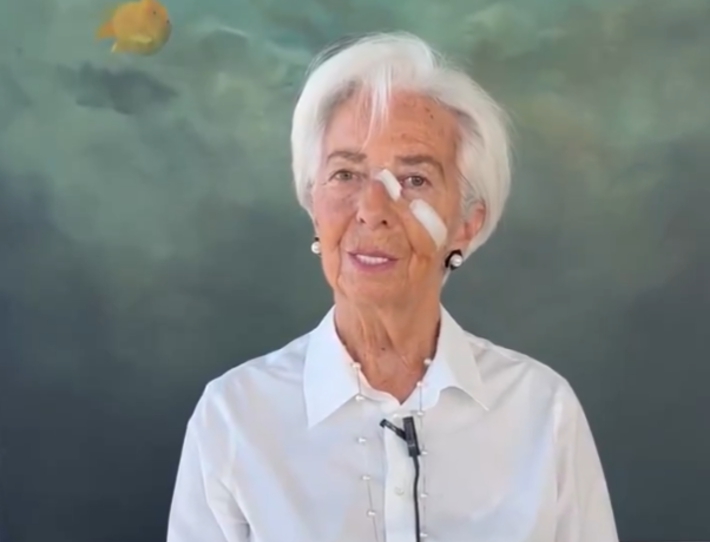
Sporting bandages on her face, Lagarde posted a video on social media today announcing her early departure from the ECB, which wasn’t due until October 2027.
“I have just informed my fellow policymakers and staff at the European Central Bank that I will be stepping down with effect on February 7, 2027, after monetary policy governing council”
Christine Lagarde, October 2026
“Just to avoid any social media chatter: the plasters on my face are due to a small surgery earlier in the week. Follow doctor’s orders and get your skin checked regularly!”
Christine Lagarde, October 2026
The ECB put out a press release today, stating, “President Lagarde’s successor will be appointed by the European Council following the nomination process outlined in Article 283 of the Treaty on the Functioning of the European Union.”
French President Emmanuel Macron also took to social media today to thank Lagarde for her time at the ECB while adding, “The transition at the head of the ECB must now be prepared in an orderly and balanced manner with our European partners.”
Sky News unbiasedly reported that Lagarde’s “early departure is, in one way, good for the ECB as it allows European leaders time to elect a replacement who is pro-EU amid a rising tide of populism within the bloc and ahead of the election in France.”
The author referred to Lagarde as “a trailblazer for women among the world’s top financial institutions.”
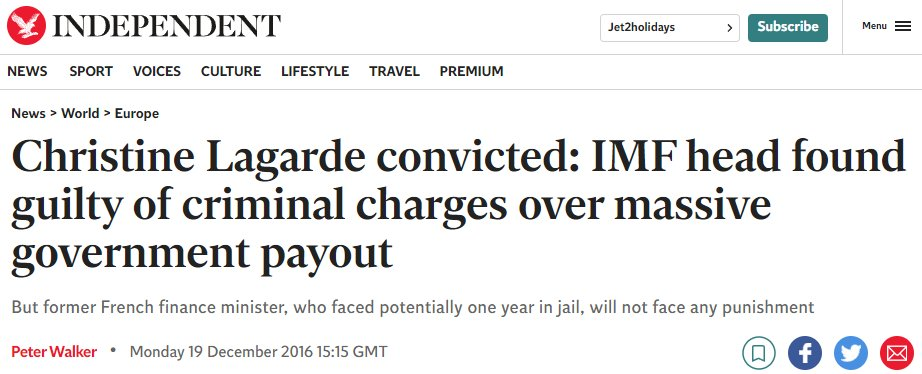
In 2016 Lagarde was convicted for her role in a massive government payout, which could’ve landed her a year in jail, yet she never served a single day.
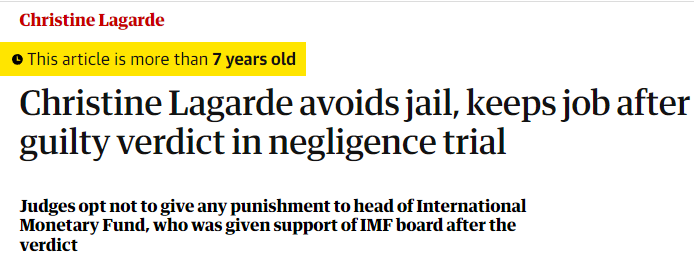
Instead, after being found guilty on charges of “negligence by a person in position of public authority” related to her role as France’s minister of finance in 2008, she dramatically failed upwards.
Lagarde was the managing director of the IMF from 2011 – 2019, and then she was almost immediately appointed president of the European Central Bank in 2019, where she still is today — lobbying for the digital euro — a digital ID-backed Central Bank Digital Currency (CBDC) for the entire European Union.
Speculation about her early departure from the ECB ranges from it being a move to find a pro-EU replacement or even possibly a run for president of France, the latter of which she said “would not be a good idea at all.”
The Financial Post reports, “Lagarde’s premature departure risks drawing accusations of political encroachment on the ECB’s independence, as the timeline now allows President Emmanuel Macron to help replace her before his final terms ends. Polls suggest far-right candidate Marine Le Pen could win the first round of elections for the Elysee.”
In her words, though, Lagarde said she was stepping down because she “can’t remain neutral.”
“I want to have the freedom of speech, the freedom of expression, and the freedom to engage on matters that are not monetary policy matters. I don’t think that I can remain neutral. I don’t think that I can be comfortable in that neutrality at the present time.”
Her exit; however, also opens the door for her to become the next WEF chair of the board of trustees.
In May 2025, the Financial Times reported, “Christine Lagarde has discussed cutting short her term as European Central Bank president to become chair of the World Economic Forum, according to WEF founder Klaus Schwab.”
“Schwab told the Financial Times that Lagarde had been at the center of a plan both had discussed for ‘several years’ for her to replace him as head of the WEF.”
The WEF currently has two interim co-chairs, BlackRock CEO Larry Fink and Roche pharmaceuticals vice-chair Andre Hoffmann.
On March 14, 2026 Swiss publication NZZ published an interview with Schwab, in which the WEF founder said he still preferred to choose his own successor as executive chair, stating he wanted someone who was smart, trustworthy, and “who is independent, has no conflicts of interest, and brings experience from both the public and private sectors.”
“You are describing the profile of ECB president Christine Lagarde,” said the interviewer, to which Schwab responded, “I don’t want to mention any names.”
Lagarde has for long been a member of the WEF board of trustees, which counts 27 members.
As far as policy at the ECB goes, Lagarde has been instrumental in bringing about the realization of the digital euro, which is slated to run as a pilot program next year.
According to the ECB:
“The ECB aims to be ready for a potential first issuance of the digital euro during 2029, assuming the digital euro Regulation is adopted in 2026. To lay the groundwork for a seamless and secure launch, we expect to run a 12‑month pilot starting in the second half of 2027.
“The ECB will only decide whether to issue a digital euro once the Regulation has been adopted, and the Eurosystem’s preparation work will remain flexible to ensure it stays aligned with the legislative process.”
In March 2023, Lagarde spoke at the Bank for International Settlements (BIS) Innovation Summit, saying that central banks had no interest in programming CBDCs with terms of use or expiry dates, but that commercial banks most certainly did.
“For us [central banks], the issuance of a digital currency that would be central bank money would not be programmable […] Those who can associate the use of digital currency with programmability would be the intermediaries — would be the commercial banks”
Christine Lagarde, BIS Innovation Summit, March 2023
The WEF holds its flagship annual meeting every January in Davos, Switzerland.
Will Lagarde be named chair of the WEF by then, as Schwab reportedly intended?
Image Source: Screenshot of Christine Lagarde announcing she was stepping down from the ECB on her X account