


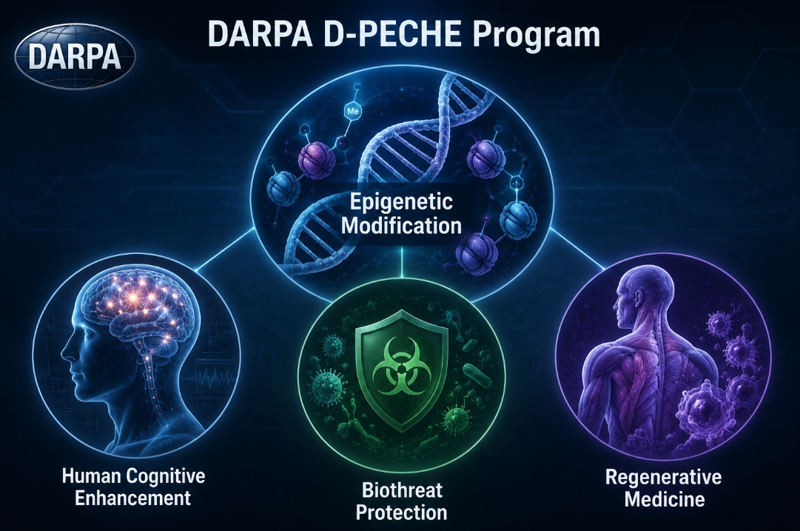


DARPA is looking to write and erase epigenetic base modifications in DNA that could be used for cognitive enhancement, biological threats protection, and regenerative medicine.
The US Defense Advanced Research Projects Agency (DARPA) DNA-Protein Epigenetic Chemistry Engineering (D-PECHE) program aims “to develop novel methods of modifying DNA bases in living cells and validate the presence of new base modifications catalyzed in vitro,” according to the special notice.
Instead of permanently altering DNA, epigenetic modification has the potential to be reversible “without altering the underlying genetic sequence.”
As such, “Writing and erasing new-to-nature base modifications will require new technologies capable of catalyzing new chemical modifications to DNA in vitro.”
“Unlike permanent genome editing approaches, epigenetic modifications are potentially reversible and offer a compelling avenue for dynamic, context-sensitive biological control”
DARPA, D-PECHE program, May 2026
“The ability to precisely modulate DNA-protein interactions has profound implications for fields ranging from regenerative medicine and cognitive performance improvements to countermeasures against biological threats and environmental stressors“
DARPA, D-PECHE program, May 2026
The Pentagon has long been in the business of attempting to create biologically engineered super soldiers.
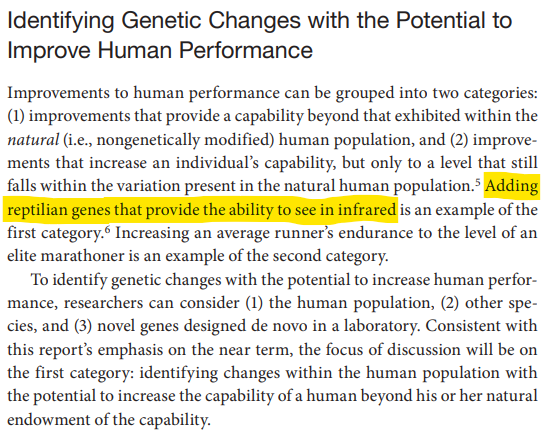
For example, a Pentagon-sponsored RAND report published in 2021 outlines the technological potentials of this controversial transhumanist research, which includes potentially “adding reptilian genes that provide the ability to see in infrared,” and “making humans stronger, more intelligent, or more adapted to extreme environments.”
Human Performance Enhancement Examples: “Adding reptilian genes that provide the ability to see in infrared […] Increasing an average runner’s endurance to the level of an elite marathoner […] Increase the capability of a human beyond his or her natural endowment of the capability”
RAND, Technological Approaches to Human Performance Enhancement, November 2021
If successful, these “people” would have the potential to never tire and think smarter, move faster, jump higher, see farther, hear better, hit harder, live longer, adapt stronger, and calculate quicker than any other human being on the planet.
Now, DARPA is looking to epigenetics to potentially make processes like some of the ones above reversible.
“Epigenetic modifications such as DNA methylation, histone post-translational modification, and chromatin remodeling can regulate gene expression and DNA-protein interactions without altering the underlying genetic sequence”
DARPA, D-PECHE program, May 2026
“DARPA is soliciting innovative proposals to demonstrate proof-of-concept for novel mechanisms for writing and erasing epigenetic base modifications in DNA”
DARPA, D-PECHE program, May 2026
The main point of contact for DARPA’s D-PECHE program is Dr. Aric Lu, who earned his PhD in bioengineering at Harvard in 2024.
Dr. Lu is listed as an Innovation Fellow — and not an official program manager –on both the DARPA website and on his LinkedIn profile.
At Harvard, Dr. Lu “used genetic engineering technologies to create patterns of cell types and of gene expression within bio-printed tissues,” according to his DARPA bio.
In an interview with Harvard’s Wyss Institute for Biologically Inspired Engineering “Humans of Wyss” series in 2023, Dr. Lu explained what type of real world problems he was looking to solve:
“If we could one day use genetic engineering and 3D bioprinting to create tissue to repair or replace an organ, that would be incredibly valuable for people with a variety of diseases, including those waiting on transplant lists,” he said, adding, “however, to get to the point, we need printed tissue that can behave like human tissue.”
“D-PECHE performers must leverage expertise in nucleic acid chemistry, protein engineering, and synthetic biology to overcome challenges in writing and erasing epigenetic modifications. If successful, this will de-risk a broader concept of epigenetic editing platforms and their potential applications”
DARPA, D-PECHE program, May 2026
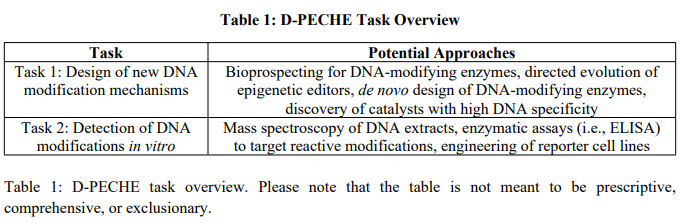
The D-PECHE study will consist of 2 main tasks:
- Demonstrate the ability to design DNA-modifying mechanisms to write and/or erase DNA base modifications. Identify target modification, catalyst candidates, and substrates and cofactors required for base modification. Identify any changes to protein sequences or domains needed for functionality within living cells.
- Detect DNA modifications in vitro. Demonstrate biocompatibility of targeted modification in host cell line. Develop assays to detect base modifications. Establish approaches to detect novel modifications in cells.
“D-PECHE hypothesizes that novel DNA modification mechanisms that alter the biochemical properties of DNA are required to unlock new applications of epigenetics”
DARPA, D-PECHE program, May 2026
The ability to program biology is all the rage behind the scenes at the Department of War.
In December 2025, DARPA announced its Generative Optogenetics (GO) program that seeks to program biology using light as the medium of transferring information, with potential applications for aiding “extended human spaceflight.”
Genetically engineered humans, novel drugs, advanced materials, feedstocks, and agricultural breakthroughs could all potentially come out of DARPA GO.
Similar to D-PECHE, DARPA GO technologies “could unlock unprecedented capabilities in personalized improvements to warfighter health and performance, agriculture, biomanufacturing, and space exploration by providing open-ended programmability.”
For D-PECHE, DARPA lists three potential applications: regenerative medicine, cognitive performance improvements, and countermeasures against biological threats and environmental stressors.
Image Source: AI generated with ChatGPT